
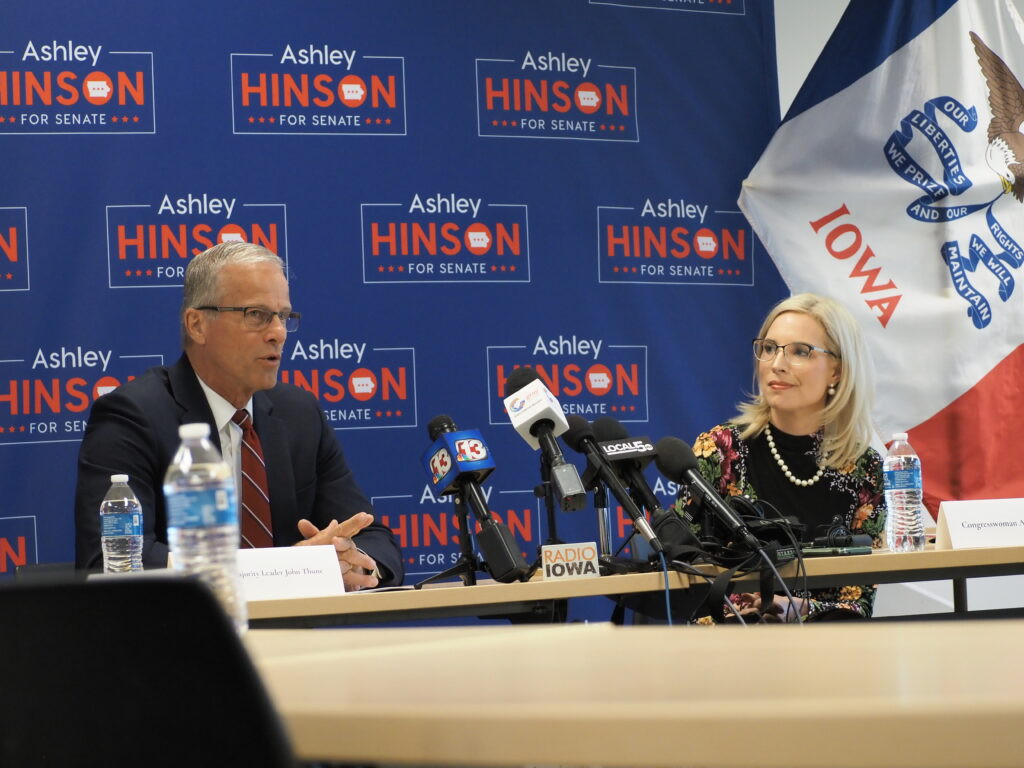
Senate Majority Leader John Thune joined U.S. Rep. Ashley Hinson, who is running for the Senate in 2026, for a roundtable discussion on the impacts of the 2025 tax law supported by the GOP-controlled Congress at the FFA Enrichment Center in Ankeny May 8, 2026. (Photo by Robin Opsahl/Iowa Capital Dispatch)
U.S. Senate Majority Leader John Thune joined Rep. Ashley Hinson for a roundtable in Des Moines Friday touting how tax law changes passed by the GOP-controlled Congress in 2025 are helping Iowa families, workers and business owners.
The discussion comes as campaign events are ramping up leading into the 2026 election season. Hinson is running for U.S. Senate, aiming to replace U.S. Sen. Joni Ernst, who is not seeking a third term.
Thune said Senate Republicans “are very much looking forward to having Rep. Hinson join us in the United States Senate as Sen. Hinson,” and continuing the work she has done representing Iowa in the House since 2021.
The event Friday at the FFA Enrichment Center in Ankeny centered on the work Hinson has done in the U.S. House supporting the “Working Families Tax Cuts” — part of the “One Big Beautiful Bill” Act President Donald Trump signed into law in July 2025. Thune called the tax and spending bill, which covered a variety of subjects from restrictions on Medicaid spending to increasing qualified deductions for tips and overtime, “the most consequential piece of legislation that we passed, by far,” during his time in Congress.
Hinson said getting this measure signed into law has produced “tangible” savings for Iowans who had been struggling with rising costs, through provisions like reducing taxes on tips, overtime and Social Security benefits.
“We just went through the tax return season, and Iowans saw more money in their pockets — the actual numbers, tax refunds increased by 11% and with an average return of about $3,500,” Hinson said. “You look at what that means for an Iowa family, that’s groceries, that’s utility money, that’s maybe a vacation with your family, extra money for sports or kids’ lunch accounts, in my case, because my kids are always texting me asking me for more lunch money.”
The Friday roundtable hosted a group of five Iowans who spoke on how they had utilized portions of the 2025 law to make investments for their own family or business. Speakers included a father who plans to start a “Trump Account” — a tax-deferred investment account for minors under age 18 — for his 5-month-old daughter, and a business owner who said the cost savings from tax cuts allowed his business to hire new interns.
Two of the speakers at the roundtable spoke in support of changes made through the 2025 tax and spending law, but said they wanted to see Congress take more action to lower the cost of healthcare.
Ginny Mitchell said she lost her job at Iowa State University in June 2025, and bought a new car which allowed her to work as an Uber driver. She said she received a larger tax return than expected when she filed this year, and that the deduction of up to $25,000 on tips through the 2025 law was “substantial” for her family. She said the change has been positive as working with Uber has allowed her to homeschool her youngest child.
However, Mitchell said she wanted to see Congress take action to make healthcare affordable. Mitchell said she lost her health insurance after losing her job at ISU.
“I can’t go get a mammogram, I can’t do these things anymore. I can’t afford it,” Mitchell said. “At first, I did. I did have health insurance through the (ACA) Marketplace. But it’s not worth it — $6,000 deductible with a ($50) copay for every visit, and paying $300 a month just for myself. You know, that’s unaffordable.”
Mitchell did not say when she left her ACA Marketplace coverage. ACA coverage has declined nationwide in 2026 as premium costs rose following the expiration of premium subsidies.
Thune said his approach would be to create association health plans that would allow small businesses and self-employed workers to form groups that allow them to purchase insurance, but said Democrats have blocked this proposal from moving forward. The Senate majority leader also said he was interested in potentially changing other aspects of the ACA, such as provisions of the bill restricting insurance companies’ ability to refuse coverage or charge higher premiums based on some aspects of people’s health, like preexisting conditions.
“Obamacare requires individual plans, individual marketplaces, to cover all these different things, right?” Thune said. “And what you ought to have, in my view, and I think this is something that you could do, re-up on it, you know, on a year-to-year basis, but give you the flexibility and the option to buy a plan that works for you. And I think insurers, if they were freed up to be able to write those types of plans … for example, I mean, I don’t need maternity coverage, right? But I might need eyes, or something, you know, ears, things that people my age have issues with. And being able to tailor or customize or individualize a health care policy that fits you is something we ought to be headed toward.”
Though Hinson is considered the frontrunner to become the GOP nominee for the U.S. Senate seat — she leads the field in campaign fundraising and has gained endorsements from Ernst, President Donald Trump and many other Republicans in Washington, D.C. and Iowa — she first must face Republican Jim Carlin in the June 2 primary. On the Democratic side, Iowa Sen. Zach Wahls, D-Coralville, and Rep. Josh Turek, D-Council Bluffs, are facing off in the primary.
Democrats are poised to potentially pick up seats in Iowa and elsewhere in the country in the 2026 midterms, as some voters have expressed disapproval of the Trump administration and Republicans’ approach to immigration enforcement, as well as changes to healthcare funding through Medicaid work requirements included in the 2025 tax and spending law as well as the expiration of Affordable Care Act premium tax subsidies.
Though political forecasters predict Iowa’s U.S. Senate seat is “likely” to remain Republican, the state’s elections are expected to be more competitive than in earlier years, especially looking at Iowa’s 1st and 3rd congressional Districts, as well as the governor’s seat. As Iowa’s races become more competitive, GOP leaders are coming to support Iowa Republicans at events showcasing how Iowans have benefitted from recent GOP policies. Earlier this week, Vice President JD Vance came to Des Moines to support U.S. Rep. Zach Nunn’s reelection campaign in the 3rd District, where he also spoke about how GOP economic policies have helped Iowa businesses and workers.
This story was originally produced by Iowa Capital Dispatch, which is part of States Newsroom, a nonprofit news network which includes South Dakota Searchlight, and is supported by grants and a coalition of donors as a 501c(3) public charity.


