
WASHINGTON, D.C. — In a move that radically reshapes the future of North American commerce, the Trump administration has formally declined to grant a clean, 16-year renewal to the United States-Mexico-Canada Agreement (USMCA).
The decision, announced following a high-stakes joint review between top trade officials from the three nations, marks the conclusion of the treaty’s historic six-year “Joint Review” window. Instead of locking in the $2 trillion trade pact for nearly two decades, Washington has forced the agreement onto a rolling, annual review cycle. The move leaves the ultimate long-term stability of continental trade in a state of ongoing negotiation until its eventual sunset in 2036.
The refusal to automatically extend the trade agreement represents a stark pivot for President Trump, who frequently championed the USMCA during his first term as a landmark replacement for the North American Free Trade Agreement (NAFTA).
Addressing reporters in the Oval Office, President Trump made it clear that his administration is leveraging the review process to squeeze better terms out of America’s closest neighbors, citing persistent trade deficits and enforcement gaps.
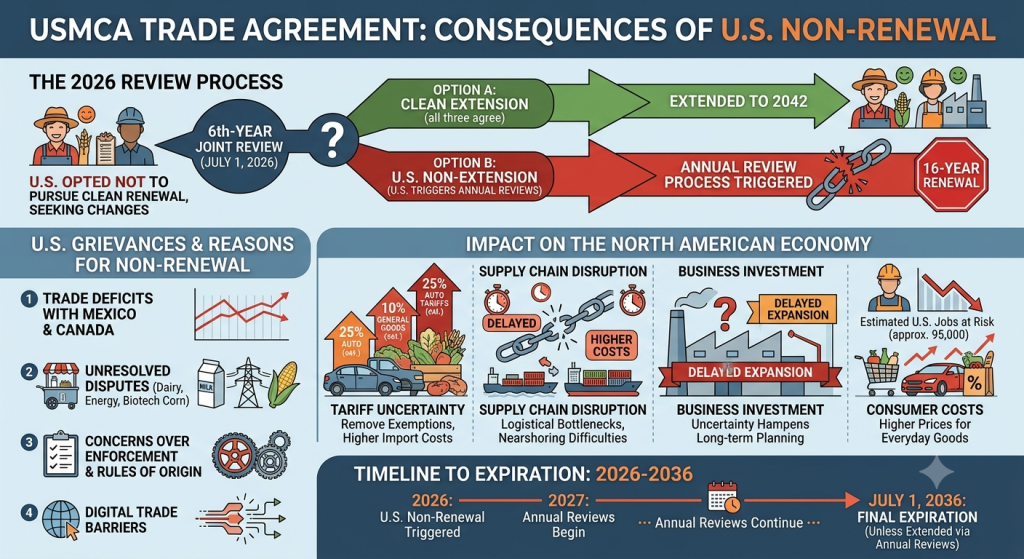
U.S. Trade Representative (USTR) Jamieson Greer echoed the president’s hardline stance, confirming that the U.S. would use the newly triggered annual review framework to aggressively address the pact’s shortcomings. Chief among Washington’s concerns are the transshipment of Chinese goods through Mexico to evade U.S. tariffs, stricter compliance with automotive rules of origin, and persistent barriers to American agricultural goods.
Agricultural Leaders React: A Mix of Support and Anxiety
The administration’s decision drew immediate, polarized reactions from the U.S. agricultural sector, which relies heavily on North American cross-border supply chains. While some commodity groups praised the administration for taking a tough stance on unresolved enforcement issues, others expressed deep concern over the long-term instability a year-to-year trade framework might bring.
Ted McKinney, CEO of the National Association of State Departments of Agriculture, addressed USMCA’s now uncertain path saying, “Even under today’s standard, USMCA is the finest trade agreement on the planet right now, as it pertains to the U.S. and as it pertains to agriculture and frankly, other things. We must keep it,” McKinney said, while acknowledging fixes are needed.
Dairy and Specialty Crop Producers Applaud the Leverage
Segments of the agricultural industry that have long clashed with Canadian and Mexican trade policies welcomed the decision. U.S. dairy producers, in particular, have frequently accused Ottawa of failing to honor its USMCA commitments regarding market access for American milk and cheese.
In a statement, Shawna Morris, Executive Vice President of the National Milk Producers Federation and the U.S. Dairy Export Council, commended the administration’s willingness to fight for a fairer deal:
“Getting USMCA right matters enormously to our industry, which ships more than 40% of all U.S. dairy exports by value to Mexico and Canada. We strongly support the U.S. government’s efforts to address these challenges and urge focused, intensive work by our trading partners to resolve them. A stronger, durable, renewed USMCA is key to the long-term prosperity of dairy producers and exporters across North America.”
Lawmakers representing farming communities also rallied behind the move. House Ways and Means Chairman Jason Smith noted that simply rubber-stamping the status quo was not in the best interest of the U.S., adding that the decision “is not a termination—it is an opportunity to strengthen enforcement.”
The Cost of Uncertainty
Despite praise from specific sectors, broader agricultural trade analysts and grain exporters warned that shifting to an annual review process introduces severe headwinds for long-term investments.
Farm operations and multinational supply chains often require 5- to 15-year planning horizons. Industry experts fear that a perpetual state of renegotiation will cause companies to delay building new processing plants or expanding cross-border distribution networks.
If annual reviews hit a standstill, the threat of localized tariffs or retaliatory measures from Mexico City and Ottawa remains on the table, potentially catching midwestern grain, pork, and poultry exporters in the crossfire.
What Happens Next?
The non-renewal does not terminate the USMCA immediately. The agreement remains fully in force, and existing preferential tariff treatments, automotive rules, and cross-border professional programs will continue operating under current regulations for the next decade.
However, the clock is now ticking on a much shorter leash. The three nations must return to the negotiating table every single year to reassess the pact. If they fail to reach a unanimous agreement to extend the pact before July 2036, the USMCA will officially expire. Formal face-to-face negotiations are scheduled to accelerate quickly, with a critical round of U.S.-Mexico bilateral trade talks set to commence in Mexico City


