

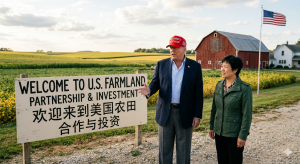
Trump’s sudden defense of Chinese investment in U.S. ag assets has introduced a fresh layer of frustration and uncertainty
WASHINGTON, D.C. – During a recent trip to Beijing, President Donald Trump defended Chinese acquisitions of U.S. farmland. Speaking in an interview on Fox News, Trump argued that restricting foreign ownership would severely damage the agricultural economy by driving down property values.
“You want to see farm prices drop, you want to see farmers lose a lot of money? Just take that out of the market,” Trump warned when questioned about Chinese nationals buying American agricultural land, including acreage near military installations.
A Sharp Policy U-Turn
The remarks mark a dramatic shift from Trump’s previous hardline rhetoric regarding Chinese ownership of U.S. agricultural assets. This sudden reversal has triggered immediate concern among national security hawks and American farmers and ranchers, both of whom have long been uneasy about Beijing’s expanding footprint in the U.S. food supply chain.
The recent comments directly contradict recent policies pushed by Trump’s own team, including the Department of Agriculture’s July 2025 “National Farm Security Action Plan” and a national security memorandum signed earlier this year targeting investments by foreign adversaries.
South Dakota Delegation Leads Pushback
The President’s comments run directly into a wall of bipartisan opposition on Capitol Hill, spearheaded in large part by South Dakota’s congressional delegation. Senators John Thune and Mike Rounds, along with Representative Dusty Johnson, have aggressively championed legislation to block exactly the kind of foreign investment Trump defended.
Senator Mike Rounds has been a leading voice on the issue, pushing the Promoting Agriculture Safeguards and Security (PASS) Act to ban China, Russia, Iran, and North Korea from buying U.S. agricultural land.
“Our near-peer adversaries such as China are looking for any possible opportunity to surveil our nation’s capabilities and resources,” Rounds previously warned, emphasizing that the U.S. cannot risk Chinese entities buying acreage near sensitive military sites.
Senate Majority Leader John Thune has staunchly backed these legislative efforts, tying the issue directly to the survival of rural economies.
“Foreign ownership of American farmland can pose major threats to our national security, especially when that land is close to sensitive military sites,” Thune stated. “This legislation would help safeguard our national defense, food supply, and rural economies and ensure farmland across South Dakota and our nation is protected.”
Representative Dusty Johnson recently doubled down on the effort by introducing the Protecting U.S. Farmland and Sensitive Sites from Foreign Adversaries Act. Johnson rejected the notion that Chinese investment is a benign economic driver for land values.
“I’ve been sounding the alarm for years that China has no good intentions when they purchase U.S. farmland, ag businesses, or land near military bases,” Johnson said. “The Chinese Communist Party is focused on collecting our private data, influencing our food supply, and threatening our national security. We can never assume their intentions are good or these purchases are random.”
Economic Strain on Farmers
The policy friction comes at a time when rural America is already facing severe economic headwinds. American farmers are currently navigating depressed commodity prices, skyrocketing fertilizer costs, and volatile export markets to China and other countries.
For a baseline agricultural sector already dealing with a fragile economic environment, Trump’s sudden defense of Chinese investment—and the resulting clash with lawmakers who view food security as national security—has introduced a fresh layer of frustration and uncertainty.


