
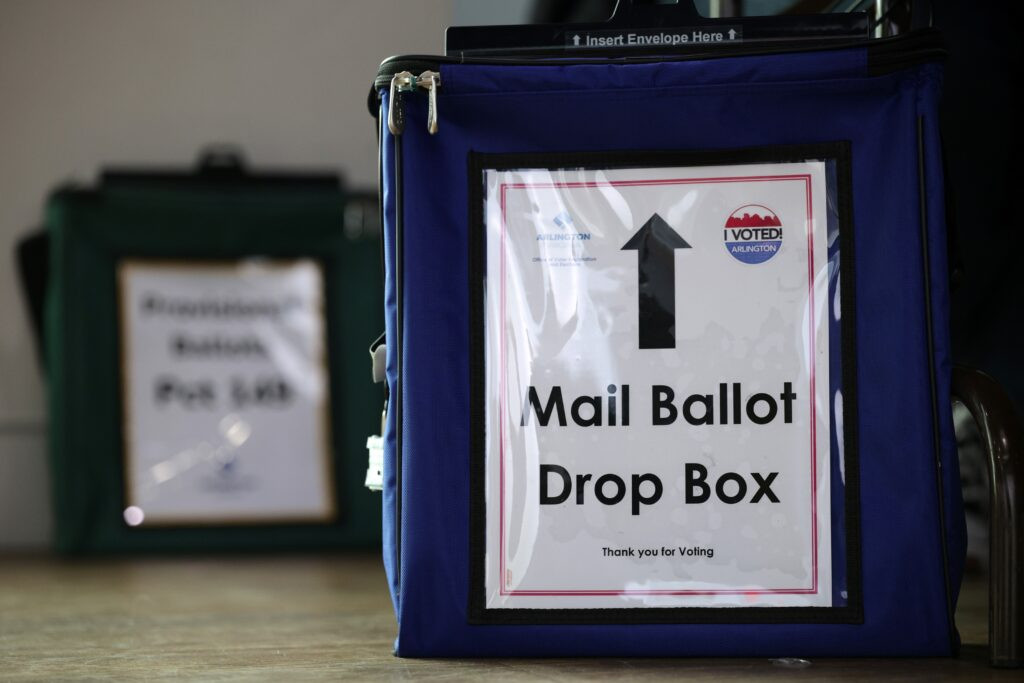
A mail ballot drop box is seen at a polling station on Nov. 4, 2025, in Arlington, Virginia. (Photo by Alex Wong/Getty Images)
President Donald Trump signed a sweeping executive order on Tuesday that attempts to restrict mail-in voting, a White House priority certain to face significant legal challenges.
The order directs the U.S. Department of Homeland Security to compile a list of voting-age American citizens and share it with state election officials. The order also requires the U.S. Postal Service to only send and receive ballots that include tracking barcodes.
Trump’s order represents a major escalation in his effort to assert presidential control over elections, which under the U.S. Constitution are administered by the states. Trump last year attempted to unilaterally impose a proof of citizenship requirement to vote in federal elections in an executive order that was blocked in federal court.
“I think this will help a lot with elections,” Trump said.
SAVE America Act
More recently, Trump has pushed Congress to pass the SAVE America Act, which would require individuals to produce documents, such as a passport or birth certificate, proving their citizenship in order to register to vote. The U.S. Senate is debating the bill, but it appears unlikely to have enough support to overcome a filibuster.
Trump previously promised to advance voting restrictions, with or without Congress. Earlier this month, Trump voted by mail in Florida.
Tuesday’s order is certain to face legal challenges. The Constitution gives Congress — not the president by executive order — the power to override state election regulations.
Marc Elias, a prominent voting rights litigator, promised to fight the executive order.
“If Trump signs an unconstitutional Executive Order to take over voting, we will sue,” Elias wrote on social media. “I don’t bluff and I usually win.”
Noncitizen voting
The move reflects a long-held focus by Trump and his allies on noncitizen voters. Studies have shown noncitizen voting is extremely rare.
“Some may freak out about this, but honestly, this is hilarious,” David Becker, executive director of the nonpartisan Center for Election Innovation & Research and a former U.S. Department of Justice Voting Section attorney, wrote on social media about the Trump order.
“It’s clearly unconstitutional, will be blocked immediately, and the only thing it will accomplish is to make liberal lawyers wealthier. He might as well sign an EO banning gravity.”
DOJ lawsuits against states
The U.S. Department of Justice has sued 29 states and the District of Columbia for copies of their voter rolls that contain sensitive personal information on voters, such as driver’s licenses and partial Social Security numbers. About a dozen states have voluntarily provided the data, but most are fighting the demands in court.
Three federal judges have so far ruled against the Justice Department. The administration is appealing and in court documents has argued that swift court decisions are necessary to ensure the security and fairness of the midterms.
The Trump administration has said the data is necessary to verify only citizens are registered to vote. Last week, a Justice Department lawyer confirmed in court that voter data would be shared with Homeland Security.
Homeland Security operates the SAVE system, a powerful computer program that can verify citizenship. DHS has previously invited states to run their voter rolls through SAVE, which flags voters as potential noncitizens. Some election officials criticize the system, saying it wrongly identifies U.S. citizens as possibly ineligible.


