

WASHINGTON, D.C. – The U.S. Department of Agriculture designated a natural disaster area in four South Dakota counties due to drought, making farmers and ranchers eligible to apply for emergency loans.
The counties are Brule, Gregory, Lyman and Tripp, in the south-central part of the state. A news release from the USDA said eligibility extends to the contiguous counties of Aurora, Buffalo, Charles Mix, Hughes, Hyde, Jerauld, Jones, Mellette, Stanley and Todd.
The designation allows the USDA’s Farm Service Agency (FSA) to offer emergency loans for needs including the replacement of equipment or livestock, reorganization of a farming operation, or refinancing certain debts. The FSA will review the loan applications based on the extent of losses, security available and repayment ability.
The four primary counties have suffered from a growing-season drought classified as severe by the U.S. Drought Monitor for eight or more consecutive weeks, or suffered from extreme or exceptional drought.
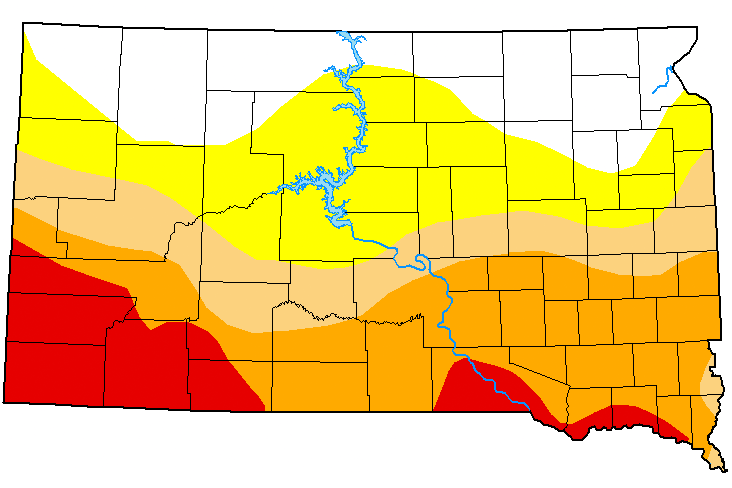
Current Statewide Drought Overview
The disaster declaration comes amid a broader, intensifying dry spell across South Dakota. According to the latest data from the U.S. Drought Monitor, nearly 80% of the state is now experiencing some level of abnormal dryness or active drought, leaving only about 21% of South Dakota reporting normal moisture conditions.
An unseasonably dry and cool late-spring pattern has rapidly expanded moisture deficits, pushing a significant portion of the state’s agricultural land into higher risk categories.
The overall footprint of the drought across South Dakota breaks down as follows:
- Exceptional Drought (D4): 0.00% (The state has currently avoided the most severe category).
- Extreme Drought (D3): 12.23% (Prevalent in sections of the south-central disaster zone and expanding into northeastern Wyoming border areas).
- Severe Drought (D2): 24.88%
- Moderate Drought (D1): 15.56%
- Abnormally Dry (D0): 26.35%
- Normal Conditions: 20.99%
While western South Dakota has seen slightly warmer conditions and occasional moisture corridors, western, central and eastern portions of the state remain locked in a dry stretch with precipitation deficits ranging from 0.6 to 1.2 inches below normal, driving the expansion of the severe (D2) and extreme (D3) drought zones that triggered the recent federal response.


