

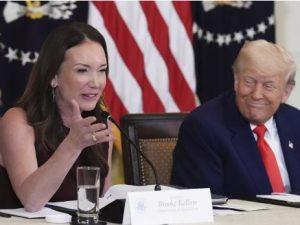
WASHINGTON, D.C. – U.S. Secretary of Agriculture Brooke Rollins, who admitted during a Spectrum News interview that she does not know which countries the government is importing beef from, is defending President Donald Trump’s decision to temporarily increase tariff-free beef imports, saying the move is intended to provide short-term relief for consumers while the administration continues working to rebuild the U.S. cattle herd.
In remarks to reporters at the Iowa State Fair, captured by Brownfield Ag News, Rollins addressed the beef import announcement following pushback from cattle producers and industry organizations.
President Trump announced August 21, 2026, that the United States will allow up to 300,000 metric tons of beef to be imported tariff-free over the next 90 days. The administration says the move is intended to help lower ground beef prices for American families.
Rollins said affordability remains a major concern for the president, particularly for families who rely on ground beef as a source of protein.
“We’re going to move in about 300,000 metric tons of just ground beef from other countries so that we can get a 25 percent decrease for families,” Rollins said. “Usually, lower-income families rely on ground beef. He wanted to make that move for the American consumer.”
Rollins acknowledged the announcement came at a time when many in the cattle industry were not prepared for the move.
“I don’t want to say unexpected, because I think the president has been talking about it for a long time, but it did come at a time when I think a lot of people weren’t prepared for it,” she said.
Still, Rollins made clear that as Trump’s agriculture secretary, she stands behind the president’s decision.
“I, of course, am the president’s secretary of agriculture. He hears from me a lot on all of these issues,” Rollins said. “But once a decision is made, I understand the decision and defend the decision, and look forward to continuing to rebuild the herd.”
Rollins also put the 300,000 metric tons into context by pointing to the administration’s restrictions on Mexican cattle due to New World screwworm.
She said more than one million head of cattle that otherwise could have entered the United States remained south of the border during the restrictions.
“What that 300,000 metric tons represents—that the president announced this morning—is about 500,000 head of cattle,” Rollins said. “So, we’re still 500,000 head of cattle less today than we would have been if we’d kept the ports open.”
Rollins stressed that the imports are intended to be lean beef used for ground beef rather than higher-value whole-muscle cuts.
“And this is all lean, right? So, it’s not the really good cuts that America is so good for,” she said.
Despite the short-term import decision, Rollins said increasing domestic cattle numbers remains critical to the administration’s long-term strategy.
“Unless we rebuild our beef herd, we will become more and more reliant on foreign countries to feed and fuel ourselves,” Rollins said. “And that is, as I’ve mentioned, an absolute no-go as we’re working to bring all of this back to America.”
Rollins said she continues to communicate cattle producers’ concerns and market information directly to Trump.
“My commitment is this: I will never stop battling for our farmers and our ranchers and ensuring that our president fully has every data point and detail that he needs to understand,” she said.
Rollins also pointed to strong consumer demand for beef and other proteins as a positive signal for producers.
“In the last year, we’ve seen a 10 percent increase in purchases, even with the prices, which would tell you that people are willing to pay these prices for great American beef and for proteins to put on their plate,” Rollins said.
“The future for American ranchers and for beef has never been brighter.”
The Trump administration’s beef deal has met with stiff resistance from ranchers who argue that allowing more imports will do little to change the underlying conditions that have sent beef prices spiking, such as low herd sizes because of drought and consolidation in the beef packing industry.


