
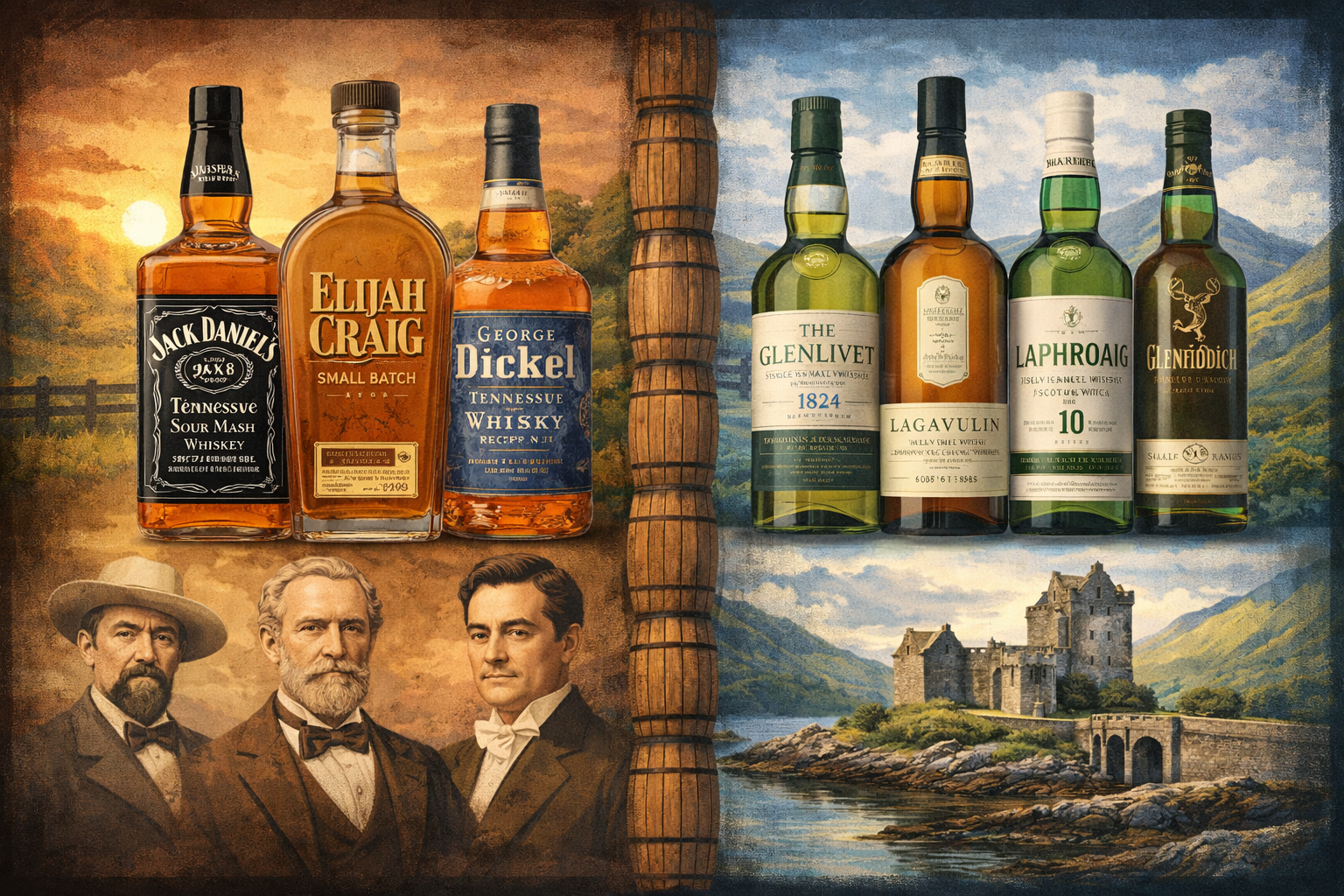
Stand in the Scotch aisle long enough and you’ll see it happen. Someone confidently grabs a bottle of Jack Daniel’s without hesitation. Then they turn to the single malt shelf and quietly attempt, “La-froyg? Laph-royg?… I’ll point.”
Whiskey drinkers will debate mash bills, aging time, and barrel finishes all night long. But there’s one difference between bourbon and Scotch that almost never comes up. The names. And once you notice it, you can’t unsee it.
Bourbon Bottles Read Like a Roll Call
Walk into any American liquor store and the bourbon shelf greets you like a reunion. First names. Last names. Names that sound like Civil War generals or the kind of guys your grandfather mentioned like he actually knew them.
Jack Daniel’s carries the name of Jasper Newton “Jack” Daniel, who started learning the craft as a teenager and built one of the most recognized whiskey brands in the world. Elijah Craig was a Baptist minister who pioneered the use of charred oak barrels. Whether every detail of that origin story is perfectly documented or got a little shinier with time, the legend stuck. George Dickel was a 19th-century merchant who believed his Tennessee whisky was smooth enough to deserve the Scottish spelling, hence the missing “e.” Jim Beam, meanwhile, represents seven generations of a Kentucky distilling family packed into two words on a label.
These aren’t abstract brand names that came out of a marketing meeting. They’re people. The founders, distillers, ministers, and merchants who actually started it all. American bourbon honors individualism in its most literal form: it puts the person’s name on the bottle and calls it done.
Even the spelling carries that identity. In the United States and Ireland, producers write it as whiskey, with an “e.” In Scotland, they write it as whisky, no “e.” One small letter, but a surprisingly large cultural statement.
Scotch Whisky Names Begin With the Land
Scotch does sometimes honor people. Johnnie Walker started with a grocer turned blender. Chivas Regal traces back to brothers James and John Chivas, who ran a shop in Aberdeen in the early 1800s. But most Scotch whiskies don’t take their names from people at all. Instead, they take them from places. And those places mean something.
A lot of distilleries begin with “Glen,” which means “valley” in Gaelic. From there, the geography gets specific. Glenlivet translates roughly to “smooth flowing one,” a nod to the nearby river. Glenfiddich means “valley of the deer,” which explains the stag on the label. Glenmorangie translates as “glen of tranquility,” though some scholars prefer “valley of great peace.” Scholars, apparently, have strong opinions about this.
The Harder Names Are Worth Knowing
Then it gets harder to pronounce.
Lagavulin, one of the most famously peaty whiskies on the planet, means “hollow of the mill.” Laphroaig means “hollow of the broad bay,” a description of the rugged Islay shoreline where the distillery has operated since 1815. Auchentoshan, pronounced AUK-en-TOSH-en, means “corner of the field.” Bunnahabhain, or BOON-a-hav-in, translates to “mouth of the river.”
And then there’s Bruichladdich. My personal favorite. Pronounced BROOK-lad-ee. It means “stony shore bank.” People who’ve never even tasted it love saying it anyway. It might be the greatest Gaelic word ever put on a bottle.
What’s worth noting is that none of these names got softened for export. Producers didn’t simplify them for easier American pronunciation or smooth them out for international markets. They stayed rooted in Gaelic, stubbornly tied to the land. So the name stays true to its origin even when the person ordering it at dinner has to gesture vaguely at the menu.
The Region on the Label Tells You Something Too
In Scotch, even the region is a signal. Islay suggests sea air and heavy peat smoke. Speyside often hints at fruit and honey. Highlands can run anywhere from delicate to full-on robust. So before you’ve even opened the bottle, you’re buying a sense of place.
That’s genuinely different from how bourbon works. Bourbon regions don’t carry the same weight on a label. The person does.
Two Different Invitations
Bourbon naming builds on people. Scotch naming builds on place. One says, “let me introduce you to the person who made this.” The other says, “let me show you where it came from.”
One bottle invites you to meet a founder. The other invites you to stand in a valley, on a shore, at the mouth of a river.
So next time you’re in front of the whiskey shelf, look at the names before you look at the proof. One might introduce you to a man with a story. Another might introduce you to a landscape that’s been shaping whisky for centuries.
And you don’t have to pronounce any of them perfectly to enjoy what’s inside.
For more stories like this, and plenty of mispronunciations along the way, listen to Rob and Mark on Whiskey at Work.
FAQ
What’s the difference between bourbon and Scotch whisky? Bourbon comes from the United States and producers make it from a grain mash that’s at least 51% corn, aged in new charred oak barrels. Scotch comes from Scotland and producers make it from malted barley, aged in oak casks for at least three years.
Why do bourbon brands use people’s names? Most classic bourbon brands carry the names of their real founders or distillers, like Jack Daniel, Elijah Craig, and Jim Beam. American whiskey culture has always leaned into individual legacy and personal story.
Why are Scotch whisky names so hard to pronounce? Most Scotch distillery names come from Scottish Gaelic, the traditional language of the region. Because producers never changed the names for international markets, the original Gaelic spelling and pronunciation stayed intact.
What does “Glen” mean in Scotch whisky names? “Glen” is a Gaelic word meaning “valley.” Many Scottish distilleries sit in valleys near rivers or lochs, so the word appears often in whisky names like Glenlivet, Glenfiddich, and Glenmorangie.
How do you pronounce Laphroaig? Laphroaig is pronounced “la-FROYG.” It’s a peaty Islay Scotch and the name means “hollow of the broad bay” in Gaelic.


