
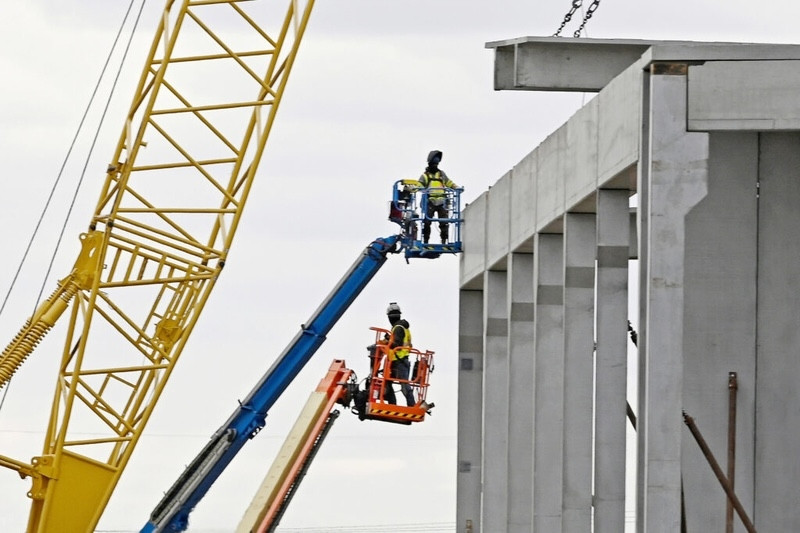
Crews work on Applied Digital data center construction in Harwood, North Dakota, on May 6, 2026. (Photo by Dan Koeck/North Dakota Monitor)
South Dakota is having the wrong argument about data centers.
This is not a debate about technology. It’s a debate about power — who gets to decide what happens to rural land, water and infrastructure when billion-dollar industries come calling.
Too many of those decisions are being made everywhere except in the communities expected to live with the consequences.
The artificial intelligence economy is coming whether South Dakota participates or not. The real question is whether the state enters that future with a plan, or rushes to approve projects before the rules are written.
Rural residents have seen this pattern before — in Black Hills mining fights, large concentrated animal feeding operations, industrial wind corridors, and now battery-storage campuses.
Data center restrictions signed into South Dakota law after push for incentives failed
The industry changes. The political script does not.
Again and again, industrial-scale projects are pushed into agricultural landscapes while local residents are told the impacts are manageable and the economic benefits inevitable and necessary.
Wind farms are not farms. Battery-storage campuses are not farms. Data centers are not farms.
They are industrial facilities, and they should be treated as such.
These operations require transmission corridors, substations, emergency-response planning and long-term pressure on roads, water systems and electrical grids. Yet South Dakota continues forcing many of them through zoning systems designed for cornfields and cattle lots.
The result is predictable. Residents fill hearing rooms. Opposition outweighs support. Citizens raise concerns about groundwater, roads, fire protection and property values.
Then they are told the project meets standards already written into law.
The public gets a hearing. The outcome too often feels predetermined.
That disconnect is what makes the data-center debate politically volatile. Rural South Dakotans are not anti-technology. They are tired of being treated as spectators in decisions that permanently reshape their communities.
Their concerns are legitimate.
South Dakota already faces pressure on water supplies, aging infrastructure and increasing competition for electricity. Into that reality comes an industry capable of consuming enormous amounts of power and, depending on cooling systems, massive quantities of water.
Skepticism is not anti-business. It is risk assessment — and it may be the last remaining form of practical conservatism in South Dakota politics.
The state possesses exactly what the AI economy wants: land, energy capacity, cold weather and political stability. That makes South Dakota attractive.
It also makes South Dakota vulnerable to negotiating from weakness.
States eager to “win” economic-development competitions often stop asking whether projects truly benefit the people expected to live beside them for decades. If a project only works through tax exemptions, subsidized infrastructure and public assumption of long-term risk, lawmakers should ask two simple questions: Who actually benefits? Who absorbs the risk?
GET THE MORNING HEADLINES.
Serious government begins with calling these projects what they are: industrial.
If a facility requires major transmission infrastructure, industrial water demand and round-the-clock emergency planning, it should be regulated as industrial development — not pushed through agricultural zoning frameworks designed for a different century.
Serious siting policy cannot stop at roads, substations and water pipelines.
Industrial siting is also a habitat issue. South Dakota sits within one of North America’s most important migratory bird regions. The Prairie Pothole Region supports globally significant waterfowl populations, while the state’s grasslands and river corridors remain critical habitat for pheasants, ducks, raptors and migratory birds that also underpin a major outdoor recreation economy.
New transmission corridors and industrial energy infrastructure fragment habitat, disrupt migration routes and increase collision risks for birds and other wildlife. Other states increasingly incorporate wildlife-corridor mapping, habitat analysis and avian-protection standards into large-scale siting decisions.
South Dakota should do the same before AI-related infrastructure expands faster than the state’s ability to manage the ecological consequences.
A state that spends millions promoting big game and pheasant hunting, waterfowl habitat and outdoor tourism cannot pretend habitat fragmentation stops mattering simply because the industry carries a technology label instead of an energy label.
Companies should also pay the full cost of the infrastructure they require. If a data center demands new substations, transmission upgrades, expanded roads or emergency-response capacity, those costs should not quietly migrate onto rural ratepayers and county taxpayers under the banner of economic development.
Counties must retain meaningful zoning authority. Local control cannot be a campaign slogan in the fall and an inconvenience in the spring. If state government overrides county decisions whenever corporate pressure intensifies, then “local control” becomes meaningless.
Quotation
Skepticism is not anti-business. It is risk assessment — and it may be the last remaining form of practical conservatism in South Dakota politics.
A serious framework also requires transparency. Before approvals occur, companies should disclose projected water withdrawals, energy demand, cooling methods and infrastructure impacts. Independent hydrological reviews should be mandatory and funded by the applicant, not taxpayers. Drought-contingency restrictions should ensure industry, agriculture and households operate under the same reality when water supplies tighten.
This is not anti-business. It is the minimum standard for responsible governance.
When rural residents conclude that corporations operate under one set of rules while ordinary citizens operate under another, public trust collapses. Cynicism spreads. People stop believing economic growth is designed to benefit them — and they stop believing that state government is on their side.
If South Dakota approves billion-dollar industrial projects without a statewide siting plan, transparent water rules and real county authority, that is not “pro-growth” competitiveness. That is surrender.
South Dakota needs a plan before the next wave of AI-driven development arrives, because once the infrastructure is built, the consequences are permanent and the leverage is gone.
Without that plan, “local control” becomes a slogan, nothing more. With it, South Dakota can welcome innovation without surrendering the people who live closest to the land — the people with the most to lose, and the most worth protecting.


