
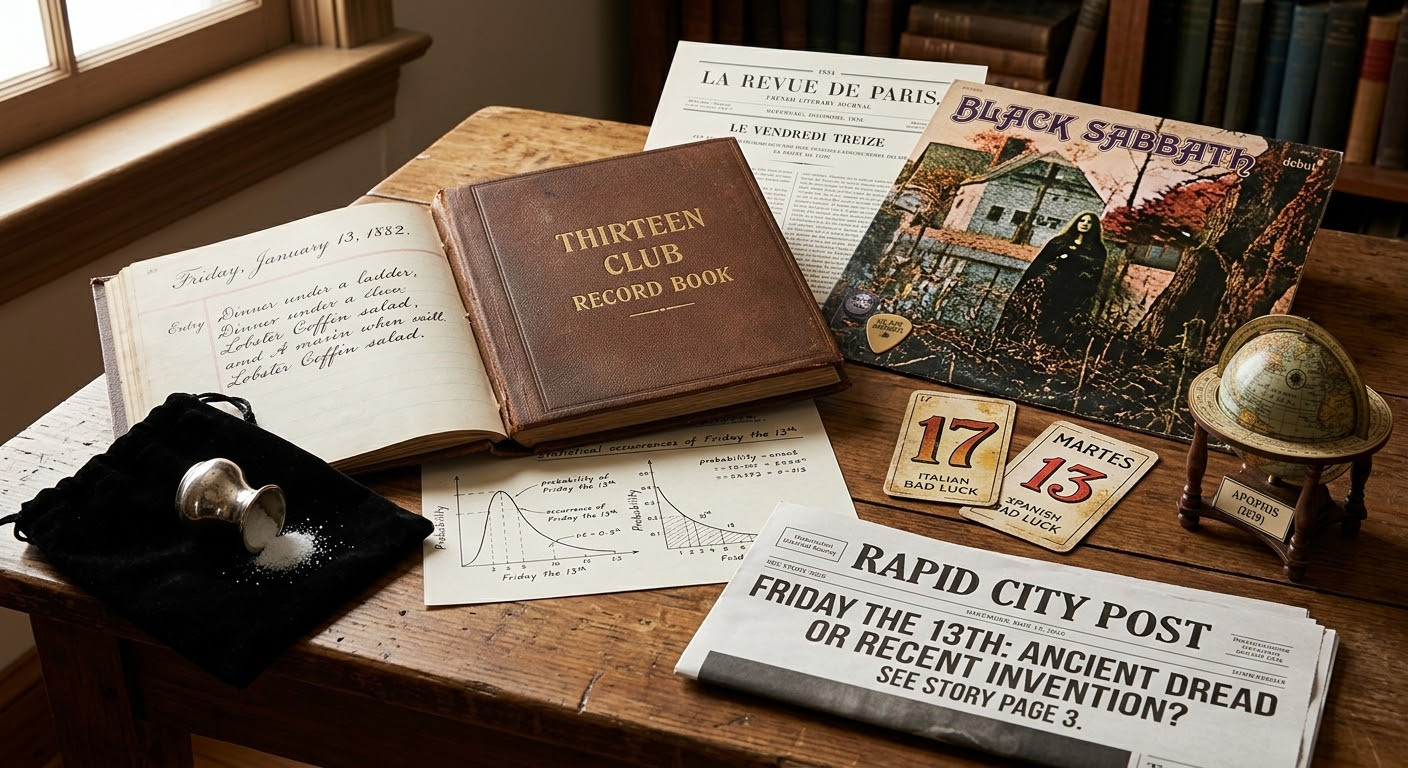
Today is Friday the 13th. You’ve probably already seen someone knock on wood, steer clear of a ladder outside their office building, or share a meme about Jason Voorhees. That is all par for the course. But the superstition you’ve been observing your whole life is, historically speaking, barely 200 years old, and it probably started in France.
Not ancient Rome. Not the Middle Ages. Not the Last Supper. France, around 1834, in a literary magazine.
This is the start of a story that involves a Civil War veteran whose personal mission was to eat dinner under a ladder with five U.S. presidents, a small Indiana town that passed a law about cats, and a night in 1970 when heavy metal was accidentally born on a Friday the 13th nobody planned.
The Superstition That Wasn’t Yet
Most people assume the dread of Friday the 13th stretches back centuries. It doesn’t. Historians looking for early documented references keep running into the same wall: the combined fear of Friday plus the number 13 on the same day doesn’t show up in any meaningful written record before the mid-1800s.
The earliest known references are French. There are two separate 1834 sources: one a literary magazine piece about a Sicilian nobleman, the other a stage comedy. The first English-language mention of the date as ominous appears in the 1868 biography of composer Gioachino Rossini, who died on a Friday the 13th. The biographer noted it as a curiosity, not as a well-known superstition his readers would recognize.
For most of the 19th century, the Library of Congress notes that American audiences considered Friday the 13th to be “exotic, European, and obscure.”
How did it become the most feared date on the American calendar? Partly through a Wall Street novel, and partly through a man who was trying to kill the superstition entirely.
The Civil War Veteran Who Ate Dinner Under a Ladder With Five Presidents
Captain William Fowler was born in 1827, and the number 13 followed him everywhere. He attended Public School Number 13, graduated at 13, built 13 buildings, and belonged to 13 fraternal organizations as the 13th member of each. He marched to Washington on April 13, 1861, at the start of the Civil War, fought in 13 battles, and on September 13, 1863, he bought a bar on Sixth Avenue in New York called the Knickerbocker Cottage.
Then Fowler decided to fight back.
He spent a full year trying to find 12 friends brave enough to sit at a dinner table with him (13 people total) to publicly mock the superstition about groups of 13 at dinner. At 8:13 p.m. on Friday, January 13, 1882, the Thirteen Club held its first meeting in room number 13 of the Knickerbocker Cottage.
To enter the room, each guest walked under a ladder. The banner hanging above the table read “Morituri te Salutamus,” the phrase Roman gladiators used before combat: “Those of us who are about to die salute you.” Salt was deliberately knocked over, and nobody threw any over their shoulder. The first of 13 courses was a lobster salad molded into the shape of a coffin.
Nobody died. Everybody went home.
The club became a sensation. By 1889 it had capped membership at 1,300. Five U.S. presidents were members or honorary members: Chester A. Arthur, Grover Cleveland, Benjamin Harrison, William McKinley, and Theodore Roosevelt.
Fowler set out to defeat a superstition that barely existed in America at the time. By getting presidents involved, generating newspaper coverage at every dinner, and staging elaborate theatrical mockery of the number 13, he likely did more to plant the idea in the American consciousness than to erase it. By the time the club faded in the 1920s, Friday the 13th was a firmly established belief.
Fowler himself died peacefully in his sleep in 1897 at age 70 in what every account describes as perfectly good health.
A Town in Indiana Put Bells on Its Cats
The town of French Lick, Indiana, passed an actual municipal ordinance in October 1939 requiring every black cat within town limits to wear a bell on every Friday the 13th. The documented rationale preserved in local records noted that the measure had been suspended one year, during which “a number of minor mishaps occurred,” and was subsequently reinstated.
This was not a joke. It was a town government making a formal decision.
Meanwhile, the fear wasn’t even uniform across cultures. In Italy, the unlucky date was, and still is for many, Friday the 17th. In Roman numerals, XVII can be rearranged to spell VIXI, a Latin phrase meaning “my life is over.” In Spain and Greece, Tuesday the 13th carries the dread, as it is linked to Mars, the god of war (the Spanish word for Tuesday is martes). When the 1980 horror film Friday the 13th was released in Spanish-speaking markets, they changed the title to Martes 13.
Finland took the most practical approach of all. Officials designated Friday the 13th as National Accident Day. The goal is not to wallow in superstition, but to focus the entire country’s attention on safety. Drive carefully. Watch your step. Pay attention. It is a day of deliberate caution rather than paralyzed fear.
The Numbers
Mathematicians have run the calendar and found something that is either comforting or deeply weird depending on your disposition. Within every 400-year Gregorian calendar cycle, the 13th day of any given month falls on a Friday more often than on any other day of the week. Not by a huge margin, but it is statistically the most common outcome. The calendar itself is biased toward the combination.
Furthermore, a Dutch insurance study from 2008 found that traffic accidents, fires, and reported thefts were actually lower on Friday the 13ths than on other Fridays. The reason is simple: superstitious people stayed home. The Centre for Insurance Statistics essentially concluded that the fear of the day partially prevents the disasters it predicts. It protects itself by being feared.
The Night Heavy Metal Was Born
On February 13, 1970, which happened to be a Friday, a British record label called Vertigo released the debut album of a band from Birmingham called Black Sabbath. Critics were not impressed. Rolling Stone called it derivative. A British music magazine dismissed it as “Black Magic Music for the Sick Masses.”
It is now considered the first heavy metal album ever made.
The release date was not a marketing stunt. Another act had failed to deliver their masters, the label needed something to fill a catalog slot, and Black Sabbath happened to have a finished record ready. The date was accidental.
So was much of the record itself. Ozzy Osbourne, Tony Iommi, Geezer Butler, and Bill Ward recorded the entire album in a single day in October 1969. The opening track’s iconic thunder and church bells weren’t even the band’s idea. The producer added them from a sound effects tape without telling anyone. When the members heard the final mix, the intro was already there. Tony Iommi’s reported response was simply, “Oh, that’s good, yeah.”
And the riff, that slow, descending tritone medieval theorists called diabolus in musica (the Devil in music), came partly from an injury. Iommi had sliced off the tips of two fingers in a factory accident before the band formed. He made prosthetic fingertips from a melted detergent bottle, switched to light-gauge banjo strings, and tuned the guitar down to reduce tension. The dark, low-tuned heaviness that defines heavy metal is partly an accommodation to a factory floor accident.
The album that opened with church bells and the Devil’s own chord was released into the world on Friday the 13th entirely by accident, and it changed music permanently.
A Celestial Coincidence
In 2029, on Friday, April 13, an asteroid named Apophis, paying homage to the Egyptian god of chaos, will pass closer to Earth than many of our orbiting satellites. It will be visible to the naked eye. Scientists have already ruled out any chance of an impact on that pass.
It seems Captain William Fowler would have found the perfect excuse to host a dinner party.


