Like the Hippocratic Oath required of newly licensed physicians, attorneys are required to take an Oath of Admission as a prerequisite for licensure. Although the precise language varies by jurisdiction, they share similar elements: a pledge to support state and federal constitutions, a commitment to the faithful discharge of the duties of an attorney, and a commitment to dealing honestly with clients and courts.
In addition to supporting the general factors stated above, South Dakota law contains a repeated commitment to integrity – legal assertions must be “honestly debatable;” there is a duty to “maintain causes only as are consistent with truth and honor;” and, “unless required by justice,” to “advance no fact prejudicial to the honor or reputation of a party or witness.” Furthermore, there are duties to preserve the “confidence and secrets of [the] client,” to abstain from “all offensive personality,” and to “never reject, from any consideration personal to myself, the cause of the defenseless or oppressed.” SDCL 16-16-18.

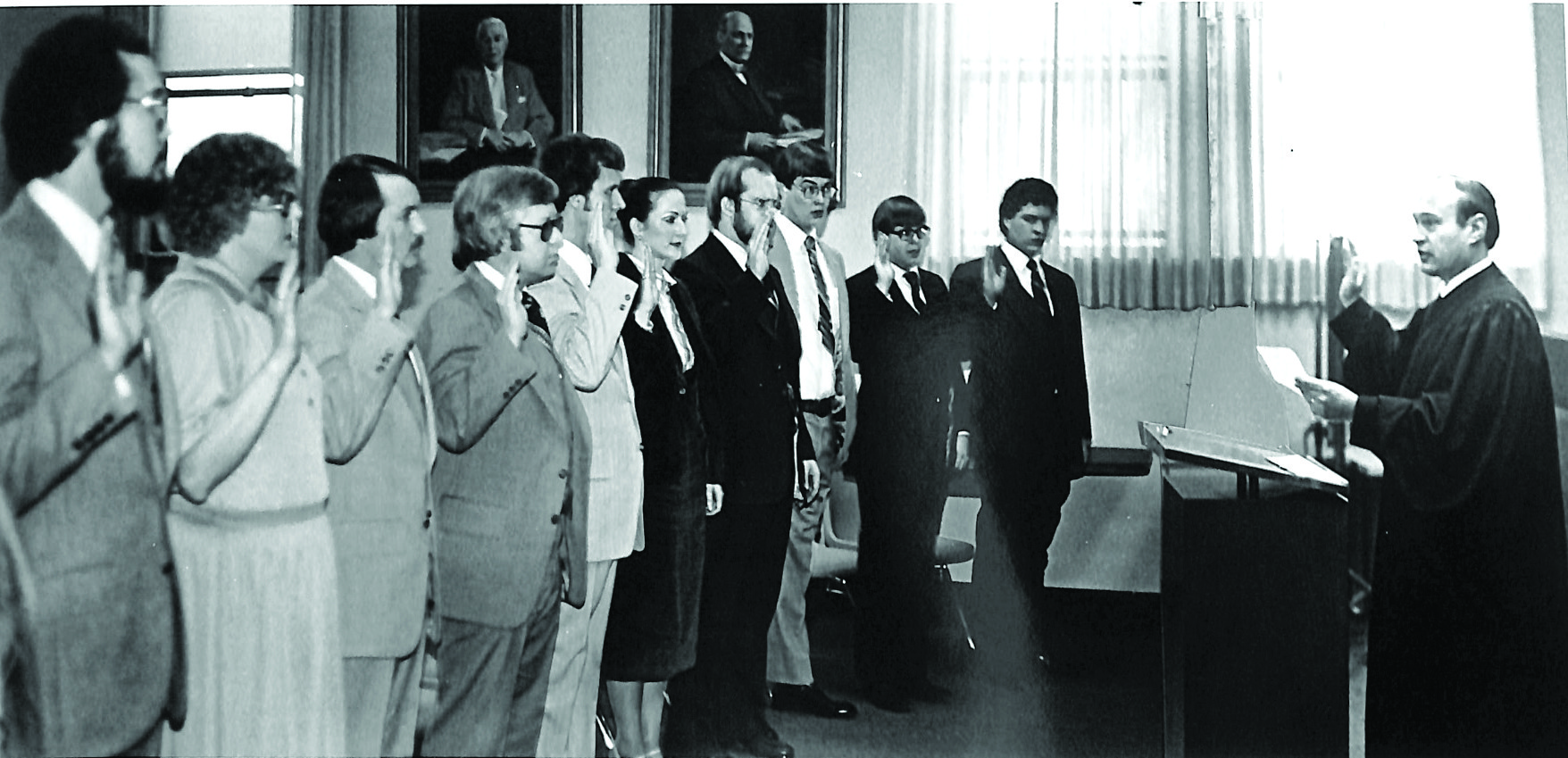
Swearing-In Ceremony conducted by Supreme Court Justice Robert Amundson for Professors Roger Baron and Charles Thatcher at the law school, May 1993. (Photo by: Claude Baron)
This oath is not aspirational or a mere formality. It is a legally binding commitment, the violation of which may subject the attorney to discipline. In re Discipline of Swier, 2020 S.D. 7, ¶ 64, 939 N.W.2d at 869 (imposing suspension from practice of law for one year, stating, inter alia, “the statutory oath for admission to become a licensed attorney in South Dakota states, in part: ‘I will maintain the confidence and preserve inviolate the secrets of my client….’”)
There has been much current discussion of the “rule of law” and how our society is seeing concerted deviations from a commitment to it. Obviously, this is relevant to the role of attorneys, who practice and administer law. As such, there is a strong linkage between an attorney’s oath of admission and our society’s adherence to the rule of law. Kristin Pawlika, President of Arkansas Bar Association, Reflecting on the Attorney Oath of Admission, Arkansas Lawyer (Fall 2024), (quoting Justice Courtney Rae Hudson’s comments at Swearing In Ceremony, “Our democracy is fragile, and the rule of law is being tested like never before … if you enter the arena and you fight the good fight, I need to warn you that the world will not necessarily stand up and applaud.”)
For decades, the State Bar of South Dakota has considered the oath to be of utmost importance. It is reproduced monthly in each State Bar Newsletter, with the hope that members will review and reflect upon its contents. For example, the April 2026 State Bar Newsletter has dedicated an entire page solely to its reproduction. Additionally, the Bar creates opportunities for attorneys to recommit to the oath in a ceremony that is not unlike a couple renewing their marriage vows.
Lawyers are subject to several ethical rules and obligations, the full nature and extent of which are not addressed in this column. The oath of admission embodies the overarching principles that should guide and govern an attorney’s conduct. The oath helps to ensure the integrity of our judicial system, protect the rights of clients, and promote the sanctity of the rule of law.
Note: For the preparation of this week’s column, the author would like to thank State Bar Officials Paul Cremer (Executive Director), Tracie Bradford (Director of Operations), and Tom Barnett (retired Secretary-Treasurer), as well as attorney Sarah Baron Houy for their assistance and input.
Anyone desiring to communicate with the Author, may do so by sending an e-mail to the author at
rogermbaron@gmail.com .
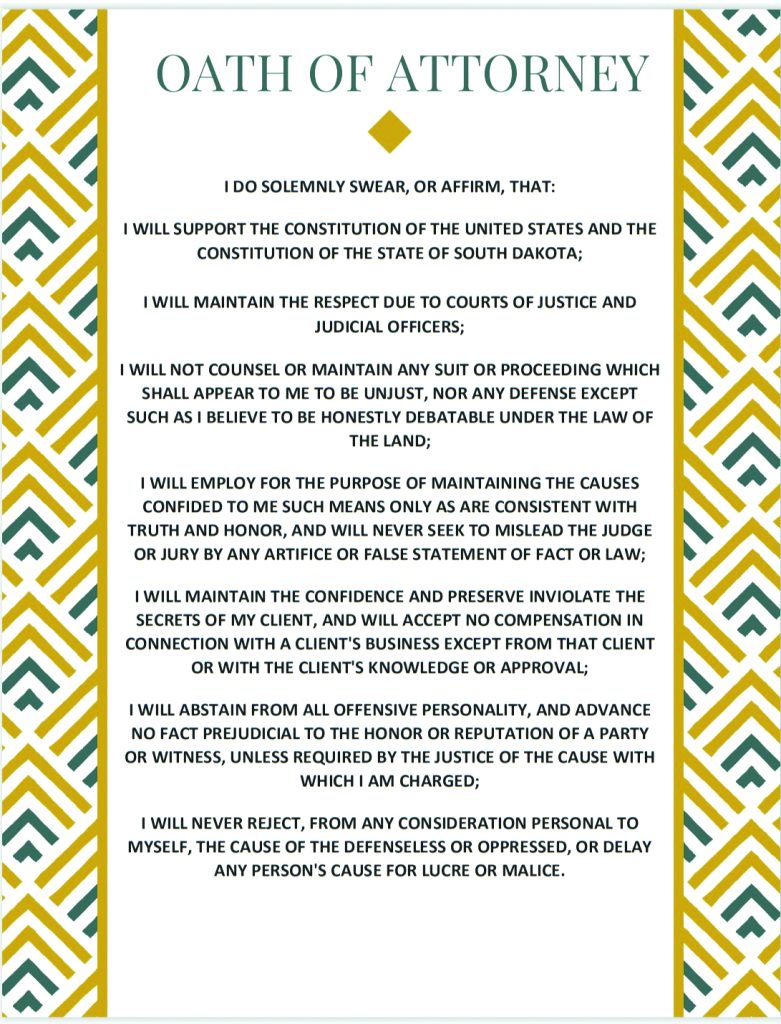
Admission Oath required for South Dakota Attorneys, as reproduced on page 69 in the State Bar Newsletter for April 2026 Newsletter (Photo: State Bar of South Dakota, Tracie Bradford, Director of Operations)
About this column: Roger Baron is a former professor of Law for 40 years. This Column is designed to provide readers with similar summaries, in non-legalese language, and to also provide a forum for other observations (notes) about relevant legal issues.
Roger Baron is a guest columnist for the Rapid City Post. Opinions expressed may not necessarily represent the views of the Rapid City Post, its affiliates, or advertisers.