For years, Henry McKenna 10 Year sat on the bottom shelf at around thirty bucks, the kind of bottle you grabbed because it was cheap and it was there. Nobody guarded it. Nobody traded it in parking lots. Then in 2019 it won Best in Show at the San Francisco World Spirits Competition, topping every whiskey on earth, Scotch included. Only one other bourbon had ever done that. And the man whose name rides the label had been dead for more than a century.
So who was he?
The Irishman Who Wouldn’t Hurry
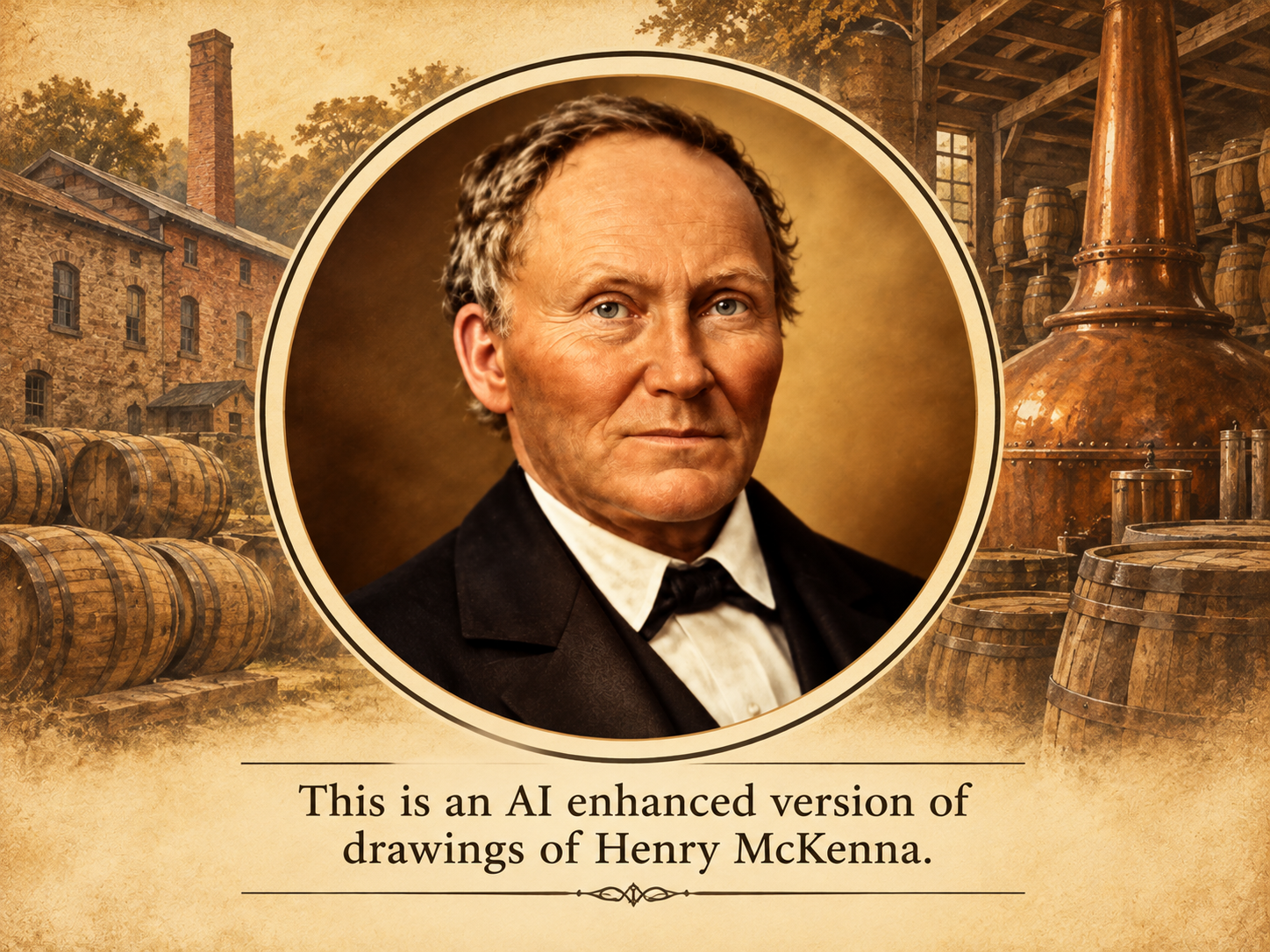
The man himself was born in Ireland in 1819 and came over as a teenager, working his way inland until he landed in Fairfield, a small town in Nelson County, Kentucky. Whiskey came later. First he built turnpikes and ran a mill, doing the ordinary work of a guy trying to get a foothold in a new country. Around 1855, he started making whiskey in a shed off the mill, not even a barrel a day.
He stayed small and fussy on purpose. The story goes that he scrubbed and boiled out his fermentation tubs to keep them clean, and the extra care gave the whiskey a cleaner start. That one’s more word of mouth than record, so I’d hold it loosely. Either way, his reputation for quality carried the name for the next century and a half. He married Elizabeth Goodwin, brought in a fellow Irish immigrant named Patrick Sweeney to run the still, and kept turning out whiskey people trusted. By the 1880s it sold well enough that he opened a sales office in Louisville and built a bigger brick distillery back home. Demand kept climbing, and by the end he was shipping well beyond Nelson County. One old tagline called it “Kentucky’s First Table Whiskey,” the bottle you kept around for an ordinary supper.
His marketing had flair, too. He sold one product as “medicinal whiskey,” its label signed by ten doctors who swore they used it in their practice. A doctor’s endorsement moved plenty of bottles in those days.
The Long Quiet Middle
McKenna died in the 1890s, and his brand settled into a long, uneventful stretch. Ownership eventually passed to Seagram, and for years most of the whiskey from the Fairfield distillery vanished into blends you would know by other names. By 1974 the distillery had shut its doors. The name survived, though, and later found a home at Heaven Hill in Bardstown, the country’s biggest family-owned distillery.
So we come back to that shelf. Henry McKenna 10 Year carried the bottled-in-bond stamp, an old federal standard for age and proof, and it aged a full decade, and it still rang up around thirty dollars. That mix turned it into a quiet favorite for people who knew exactly what they had and liked keeping it to themselves. Word stayed between friends.
Then San Francisco happened.
What Winning Costs
After the 2019 award, demand went straight up. The judges had tasted blind, no labels and no prices in front of them, and their pick outscored single malts and Irish whiskeys running two and three times the money. The bottle that used to collect dust started disappearing. Flippers cleared shelves the way scalpers work a box office. Prices climbed fast, and on the resale market bottles pushed toward a hundred and fifty. Longtime fans who used to buy it by the case couldn’t turn up a single one. For a stretch there, a bottle under a hundred bucks felt like a lottery win.
A ten-year bourbon poured in 2019 went into the barrel around 2009. So the barrel that beat the world came from Parker Beam, Heaven Hill’s master distiller, who died in 2017 after a long fight with ALS. He never got to watch his whiskey take the crown.
These days the bourbon’s easier to track down, and a bottle runs closer to fifty dollars on the shelf. If you find one at something close to reasonable, grab it for the story if nothing else. Henry McKenna spent his life making whiskey he refused to rush, and roughly a hundred and thirty years later a room full of blind judges tasted a glass and decided he had been right all along. He would probably have shrugged and gone back to work.