
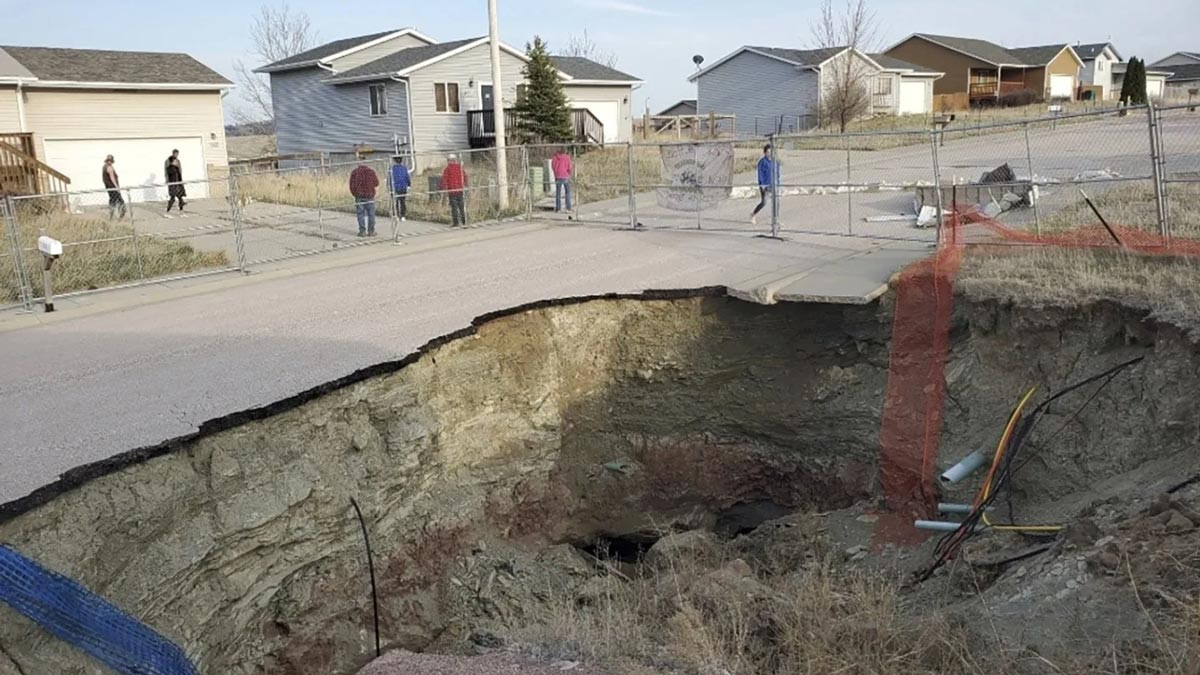
SOUTH DAKOTA – This morning, July 10, the South Dakota Supreme Court denied relief to the aggrieved homeowners in Black Hawk who experienced destruction and damage as a result of sudden and unexpected Sink Holes.
In a class action lawsuit filed in Meade County, the homeowners pursued a theory of inverse condemnation against the State of South Dakota, asserting that mining activities at the State’s Cement Plan created the Sink Hole problems. Plaintiffs had alleged that “improper reclamation of its surface mine and failure to provide subsurface support amounted to a taking or damaging” of the Hideaway Hills Subdivision. This case was assigned to the Honorable Eric J. Strawn who granted summary judgment for the Defendants, STATE OF SOUTH DAKOTA, and/or THE SOUTH DAKOTA COMMISSION OF SCHOOL AND PUBLIC LANDS, as successors of the SOUTH DAKOTA CEMENT PLANT COMMISSION, and the SOUTH DAKOTA CEMENT PLANT TRUST. The trial court’s decision was premised on the doctrine of Sovereign Immunity, the notion that the State is immune from civil lawsuits.
This appeal was orally argued before the Supreme Court nine months ago, on October 8, 2025. The ruling by the high court was a unanimous (5-0) ruling. The Court’s opinion is authored by Retired Justice Janine Kern who was on the bench at the time the case was submitted. Newly appointed Justice Robert Gusinsky did not participate in this case.
The Court expressed a bit of sympathy for the landowners toward the end of its opinion, stating in ¶45, “While we acknowledge the devastating and sympathetic circumstances in which Plaintiffs find themselves, our review is limited to the claims before us, and Plaintiffs have not presented viable claims against the State in the present action.”
A copy of the Supreme Court’s opinion may be obtained by sending an e-mail request to rogermbaron@gmail.com .


