
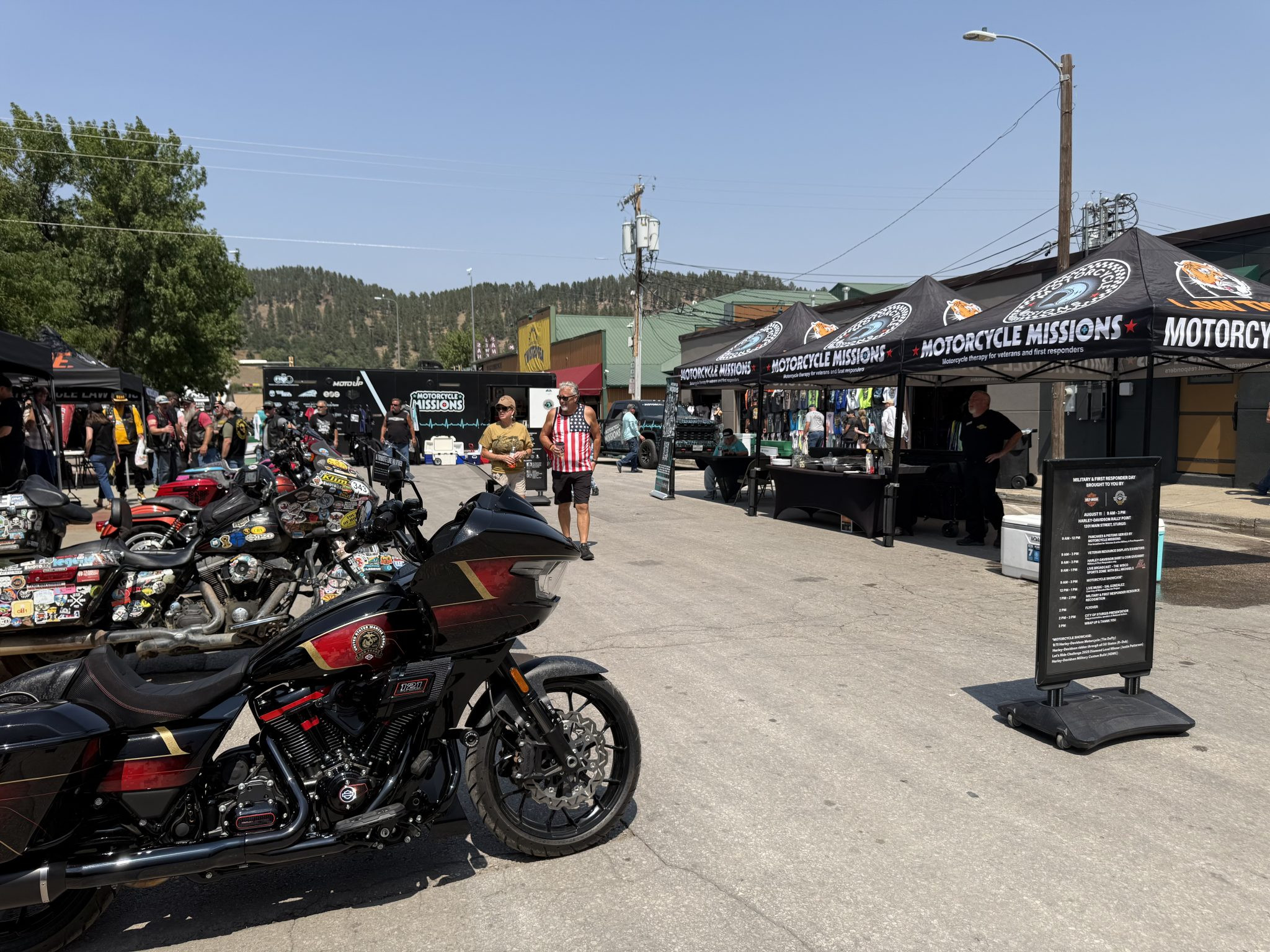
STURGIS, S.D. — As the Sturgis Motorcycle Rally recognized military members and first responders Tuesday, an organization at Rally Point was showing how motorcycles can provide more than transportation or recreation. For Motorcycle Missions, they can also provide a path toward healing. Motorcycle Missions is a nonprofit organization that uses motorcycles and motorcycle building as a form of therapy for veterans and first responders dealing with post-traumatic stress disorder and other mental health challenges.
Darren Chartier, president of Motorcycle Missions, said the organization began after its founder, Crystal, discovered how therapeutic building a motorcycle could be. Surrounded by military members and first responders, she began hearing similar reactions from others. Chartier said working on motorcycles allowed participants to get things “out and off of their chest” by focusing on something different rather than sitting with difficult thoughts. That realization eventually grew into Motorcycle Missions, which is celebrating its 10th year in 2026.
Chartier said the response from veterans and first responders who have participated in the program has been significant. “Every one of them has a story,” he said, adding that some participants have told the organization its programs saved their lives. “That means we’re making an impact. And that’s what it’s all about, is about impact.”
While much of Motorcycle Missions’ work is based around Austin and Georgetown, Texas, the organization works with veterans and first responders from across the country. Its programs include motorcycle racing and professional-level motorcycle builds, with projects previously taking place in communities including Cleveland, Chicago, Temecula, California, and Sarasota, Florida.
For Chartier, success is not necessarily measured by how many people the organization reaches at once. He said helping one person find a sense of belonging can be enough. “If it’s one person, it’s 10 people, it’s 100 people, that’s great, but it’s the one at a time,” Chartier said. “Make the impact. Do something that makes them feel like they belong.”
Motorcycle Missions operates as a grassroots organization and its staff members are volunteers. Chartier said money raised through individual donations and merchandise sales goes directly toward programs supporting veterans and first responders. Many of those volunteers have not served in the military themselves. “This is our way of giving back to the people who have served us,” Chartier said. The organization also welcomes people interested in volunteering, with information and an application available through its website.
For veterans or first responders who may be struggling, Chartier said the first step can also be one of the most difficult: reaching out. “Talk to somebody,” he said. That communication does not have to happen face-to-face or even verbally. Chartier said someone can begin by reaching out online and simply saying they need help, someone to talk to or the camaraderie and brotherhood that can come from connecting with others who understand. “You just need to reach out and tell somebody, ‘I need something. I need some help. I need somebody to talk to. I need some camaraderie. I need the brotherhood. I need something different than what I’m in today,’” Chartier said.
Those interested in Motorcycle Missions, including veterans and first responders seeking information about its programs or people interested in volunteering, can learn more at MotorcycleMissions.org.


