
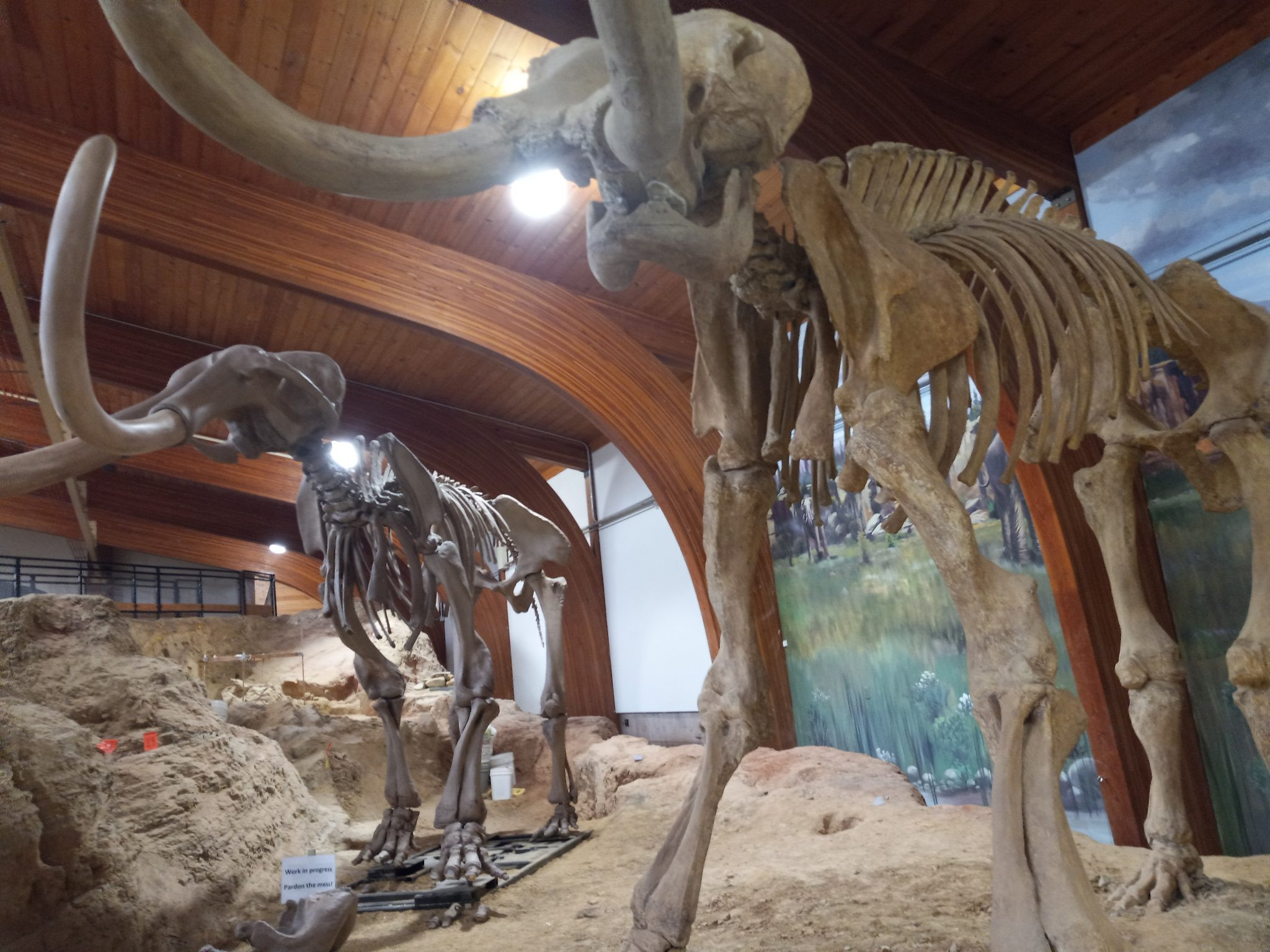
HOT SPRINGS, S.D. – Researchers from The Mammoth Site of Hot Springs, South Dakota, have published the results of their study using infrared-stimulated luminescence to re-date The Mammoth Site, with the new dates ranging from 160,000 to 232,000 years ago.
“The re-dating of the Mammoth Site suggests that the site is over 100,000 years older than we once thought. At a broad level, the work reflects the importance of continuing to test previous interpretations and really highlights the significance of our preservation of much of the site in situ,” Dr. Chris Jass, Principal Investigator, Mammoth Site, one of the co-authors of the study, said. “The work was possible because we’ve preserved not only the bones, but also part of the sinkhole itself. Given the new age estimates, we can revisit and reevaluate other interpretations about the site.”
According to The Mammoth Site Public Relations Coordinator Claire Scarborough, the new dates open up entirely new research questions for the Mammoth Site such as climate in the Black Hills during the Ice Age and what’s seen in the sinkhole while comparing specimens and sediment from a glacial cycle to specimens and sediment from an interglacial cycle.
Scarborough said the findings also help the site develop a better understanding of why some Ice Age animals are in the sinkhole but not others.
The paper, “Age reassignment using luminescence dating for The Mammoth Site, Black Hills, South Dakota, USA,” was published in the scientific journal Quaternary Research on August 11, 2026. The study was led by Shannon Mahan (United States Geological Survey) and Dr. Jim Mead (Emeritus Researcher, Mammoth Site), and was co-authored by Paul Hanson (University of Nebraska), Emma Krolczyk (USGS), and Dr. Chris Jass (Principal Investigator, Mammoth Site).
“(The paper) also gives us an opportunity to explore questions about the life history of mammoths across a broader time span,” Jass said. “It’s an incredibly exciting opportunity to re-evaluate much of what we thought we knew about not only the Mammoth Site, but also the Ice Age history of the fauna of the Black Hills region.”
The Mammoth Site is a 501(c)(3) nonprofit organization dedicated to the mission of preservation, research, and interpretation of the late Ice Age record found at the site in Hot Springs, South Dakota.


