Before Woodstock. Before tie-dye. Before the word “stoner” was even a thing, someone in ancient China was writing down notes about a plant that helped with rheumatism, gout, malaria, and, apparently, absent-mindedness.
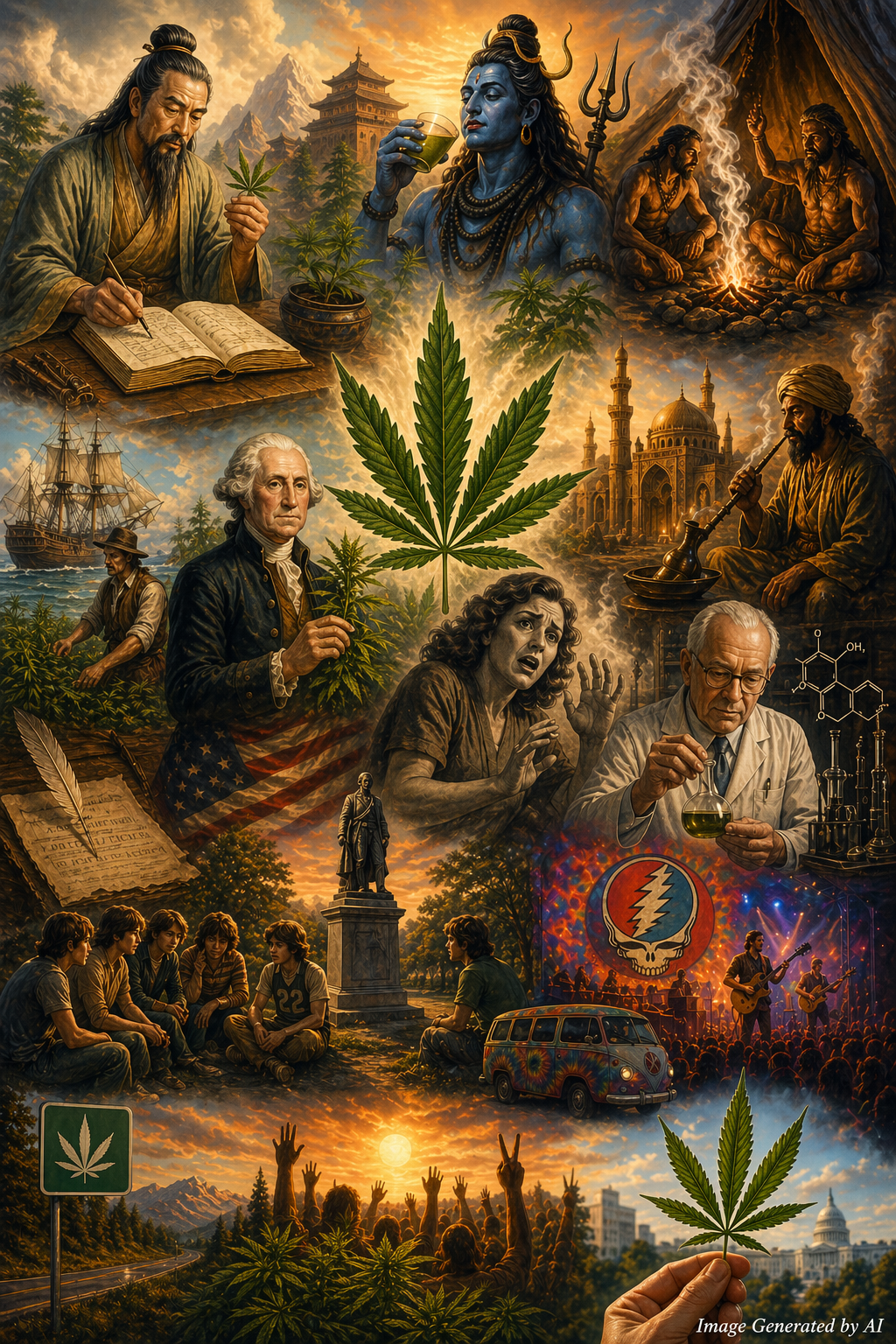
That someone was Emperor Shen Nung, regarded as the father of Chinese medicine. Around 2800 BC, cannabis made his list. Not as a party drug. As medicine. By 100 AD, Chinese healers had catalogued more than 100 medicinal uses for the plant.
A Drink, a God, and a Tent Full of Smoke
The plant traveled.
Around 1000 BC, India had a cannabis-infused milk drink called bhang, used as an anesthetic and as an offering. Hindu legend gave the god Shiva the title “Lord of Bhang” because cannabis was supposedly his favorite food. In 440 BC, Greek historian Herodotus wrote about nomadic Scythians who heated rocks, built enclosed tents, and inhaled hemp vapors until they were shouting for joy. The first hotbox, give or take a few thousand years. In the Muslim world, where alcohol was prohibited by the Koran, cannabis filled the gap.
America Grows It, Then Bans It
In 1619, Jamestown Colony passed the first cannabis-related law in the New World, ordering farmers to grow Indian hemp seed. George Washington grew it. There’s even some evidence he smoked it. Dutch hemp paper held the first draft of the Declaration of Independence.
Then the mood shifted. In 1936, “Reefer Madness” hit theaters, a film designed to terrify American youth about cannabis. A year later, the Marijuana Tax Act of 1937 made possession or transfer of the plant illegal under federal law, banning something the government had previously required farmers to grow.
Scientists still hadn’t figured out what was actually in it.
The Man Who Finally Cracked the Chemistry
Raphael Mechoulam survived the Holocaust as a child and grew up to become one of the most important figures in cannabis research. In 1964, working in Israel, he got five kilograms of seized cannabis from police and went to work. After separating the compounds, he identified THC and gave the world a scientific answer to a question people had been living with for millennia.
Five Teenagers and a Treasure Map They Never Cashed In
It’s not a police code. It’s not a Bob Dylan lyric. Five high school kids in San Rafael, California coined the term, calling themselves “the Waldos” because they hung out by a wall outside school.
In the fall of 1971, a friend’s brother was growing cannabis at Point Reyes and feared getting caught. He drew a map, gave the Waldos permission to harvest it, and a plan came together. Every day at 4:20 p.m., right after football practice, the group met at the school’s statue of Louis Pasteur, smoked a joint, and headed out to find the crop.
They never found it. They kept meeting anyway.
Their phrase, “420,” spread into the Grateful Dead’s orbit through a Waldo whose brother was friends with bassist Phil Lesh. By December 1990, Deadheads in Oakland handed out flyers inviting people to smoke “420” on April 20 at 4:20 p.m. One of those flyers landed with a reporter from High Times magazine, which ran it in 1991.
When the Oxford English Dictionary added “420” in 2017, editors cited letters the Waldos had saved since the 1970s, stored in a bank vault, as the earliest documented proof.
Where Things Stand Today
As of 2024, 88% of U.S. adults believe recreational or medical marijuana should be legal, according to Pew Research. Colorado’s Mile Marker 420 sign on I-70 now reads “419.99” because people kept stealing the original.
Cannabis ranks as the most widely produced, trafficked, and consumed illicit drug in the world, with an estimated 128 to 238 million users as of 2010.
Steve Capper, one of the Waldos, went on to become a CEO at a payroll financing company in San Francisco. He met at a statue of Louis Pasteur after football practice and the world never quite forgot it.
Happy 4/20, Rapid City.
Sources: University of Sydney; Narconon; PubMed Central (Mechoulam, 1964); PBS (Waldos origin); Time (Pew Research, 2024); Wikipedia; Montana State Legislature; TD Consultancyegislature; TD Consultancy