
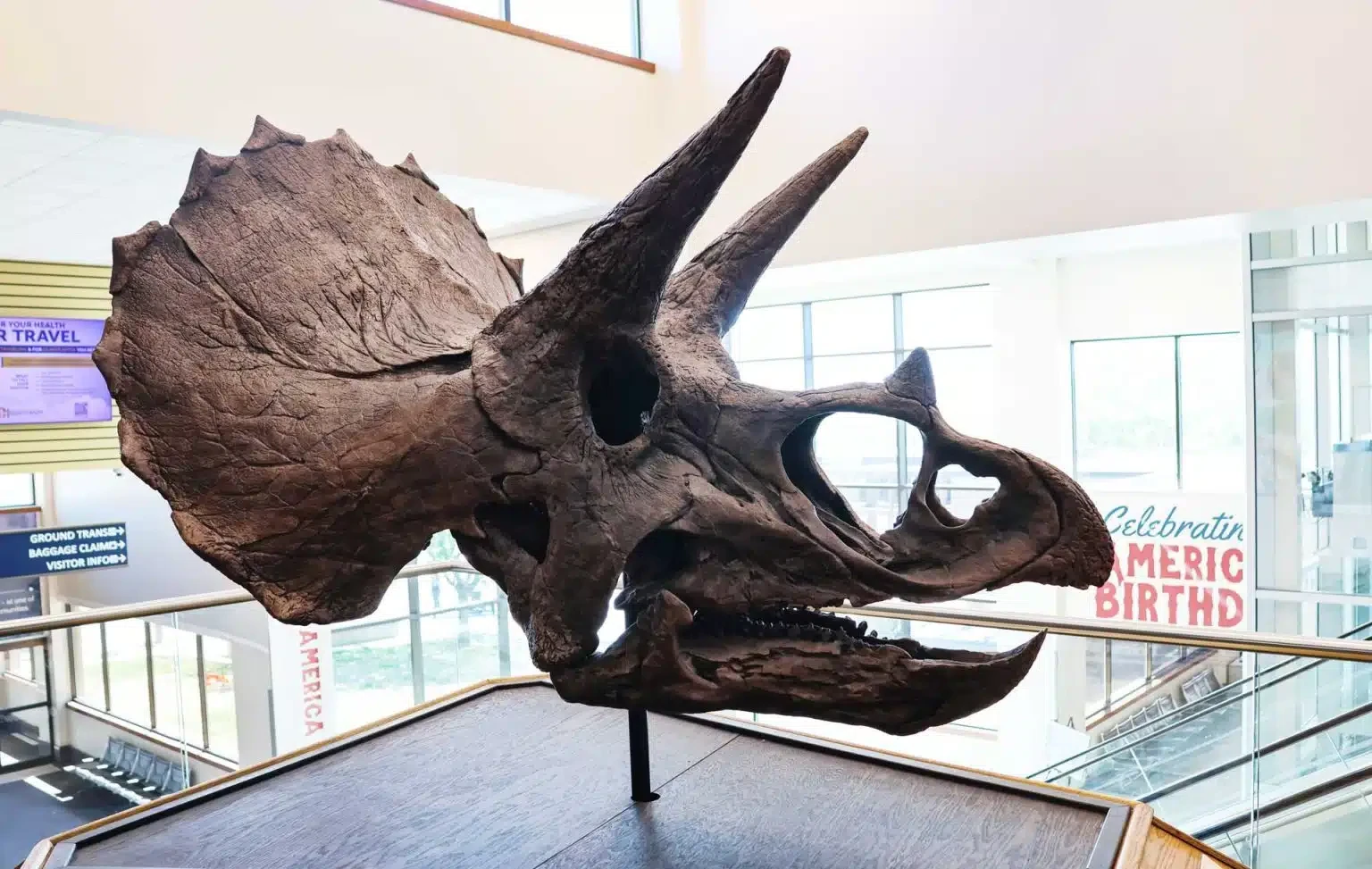
RAPID CITY, S.D. — Travelers passing through Rapid City Regional Airport now have a chance to get a glimpse of South Dakota’s prehistoric past before even reaching their gate.
A full-scale replica of a Triceratops skull has been installed inside the airport terminal through a partnership with the Black Hills Institute of Geological Research in Hill City. The exhibit is located near the TSA security checkpoint and will remain on display for approximately one year.
The Black Hills Institute has spent more than 50 years excavating and preparing fossils from the Black Hills region and around the world. Its collections include dinosaurs, mammals, fish and marine invertebrates, as well as one of the largest collections of Tyrannosaurus rex specimens in existence. The organization currently operates a museum in downtown Hill City and is preparing to open the Natural History Museum of the Black Hills in summer 2027.
Airport officials say the exhibit helps showcase one of the region’s most recognizable fossils to visitors as soon as they arrive.
“We think of the terminal as the region’s front door,” said Patrick Dame, executive director of Rapid City Regional Airport. Dame said the research-quality replica of a sub-adult Triceratops horridus skull gives travelers an opportunity to learn more about South Dakota’s state fossil as they begin their Black Hills visit. He added that airport staff have already seen visitors of all ages stopping to take photos with the display.
Black Hills Institute President Peter Larson said the exhibit is intended to spark curiosity about the area’s rich paleontological history.
“It is our hope that this little snapshot of South Dakota’s paleontological heritage will inspire visitors to seek out the wonderful natural history resources that are on display around the Black Hills region,” Larson said. He added that the institute is proud to partner with the airport to bring exhibits that highlight the region’s preserved history.
The display is accessible to all airport visitors and passengers before entering the security screening area.


