
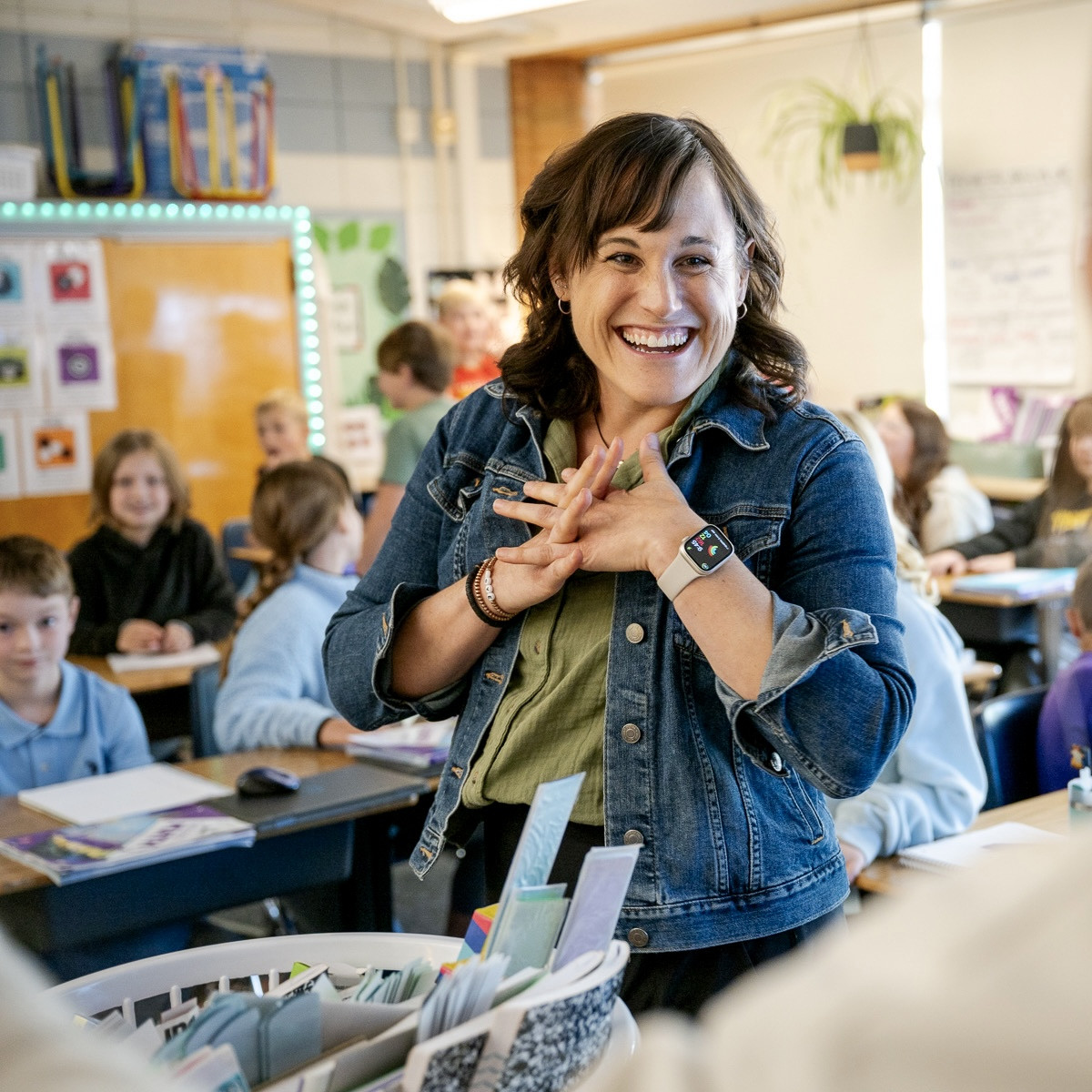
RAPID CITY, S.D. — After 20 years in education, Rapid City Area Schools Teacher of the Year Katey Swank says the lesson that has stayed with her has less to do with titles and more to do with the people who show up for one another.
Swank, who is also the Region 5 Teacher of the Year, has served as a classroom teacher, literacy coach and specialist during her career. But she said the title that may matter most is “colleague.”
“While I may be standing here with the title of Teacher of the Year, the truth is that this recognition has hundreds of names attached to it,” Swank said. “This is not my story alone. It is ours.”
Teaching was not Swank’s original plan. She attended college in St. Paul, Minnesota, where she studied art history and studio arts. One night while working in a pottery studio, she heard an NPR story about graduation rates for Native American students in her home state of South Dakota.
“I knew then that I wanted to be part of the solution,” Swank said.
She found Teach For America and entered the profession through an alternative pathway that required a two-year commitment. After training and teaching summer school in Houston, Swank began teaching at Rosebud Elementary on the Rosebud Reservation.
Her confidence quickly disappeared on the first day. Swank recalled sitting in a small classroom chair, overwhelmed and trying not to cry, when a veteran educator she called Miss Patti came in.
“She didn’t hand me a binder or tell me to just toughen up,” Swank said. “She sat with me, helped me make a plan for the very next day. And most importantly, she just made me feel like I wasn’t alone.”
Swank began relying on colleagues, including a classroom paraprofessional who taught her Lakota words and phrases and helped her better understand the community. When her two-year commitment ended, she stayed.
“Not because it was easy, but because I was supported,” Swank said.
That experience continues to influence how Swank views one of education’s biggest challenges: keeping teachers in the profession. She said school culture grows when districts intentionally invest in both students and employees.
“We talk a lot about recruiting teachers to the profession, but retention, that’s the real challenge,” Swank said. “When I reflect on why I have stayed in education for 20 years, I keep coming back to one thing: the people.”
Swank has spent the past 15 years working in several roles and buildings in Rapid City. One of the biggest changes came during a district teacher shortage when, two weeks before the school year, she was asked to return to a classroom full time after about a decade of supporting other educators.
Again, Swank said, colleagues helped her find her footing.
“I didn’t just remember how to teach,” she said. “I remembered why I love it.”
Swank later moved to Meadowbrook Elementary, where collaboration became a foundation of her classroom. Her fifth graders worked with kindergarten students, while students within her classroom learned to give feedback, solve problems together and listen to different perspectives.
Swank said one student demonstrated the power of those relationships after showing significant improvement in reading fluency. When she asked what had helped, the student credited his reading partner.
“Our students don’t only need us, they need each other,” Swank said.
As another school year begins, Swank is challenging educators to find someone they can learn from, someone they can help and someone they can build something new with.
“Collaboration isn’t just a meeting on our calendars,” Swank said. “It is a choice about how we show up for one another.”
Her challenge is simple: “Who will you show up for?”
“Because what we do for one another matters,” Swank said.


