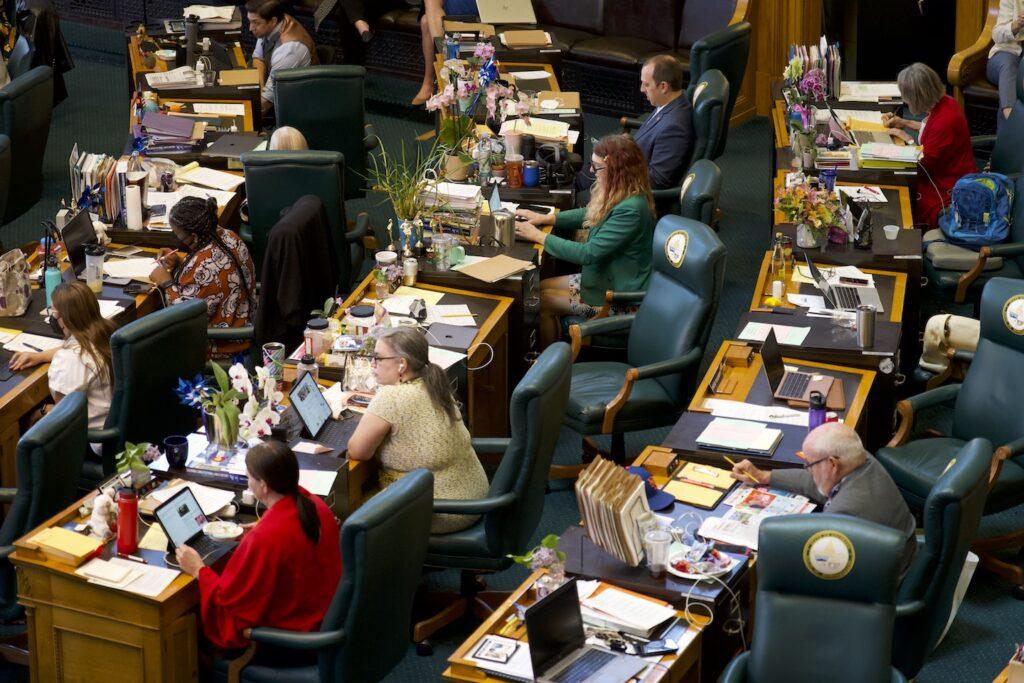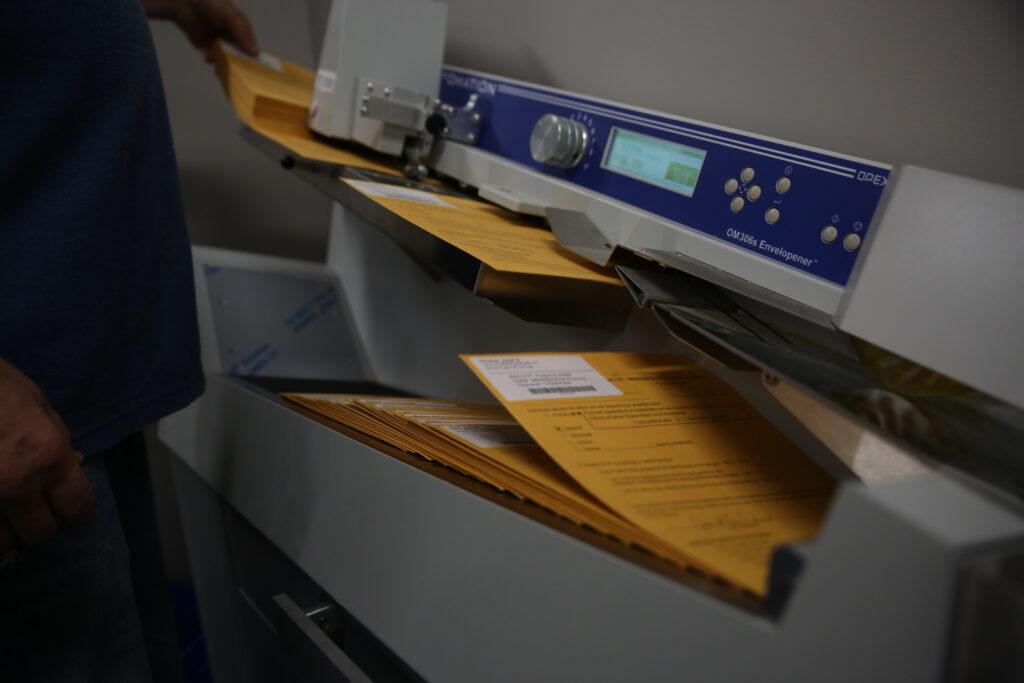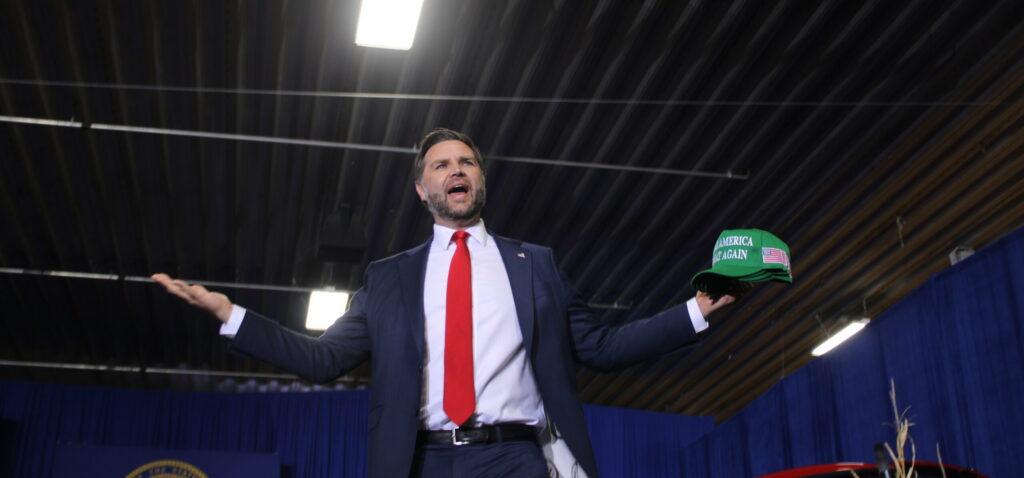
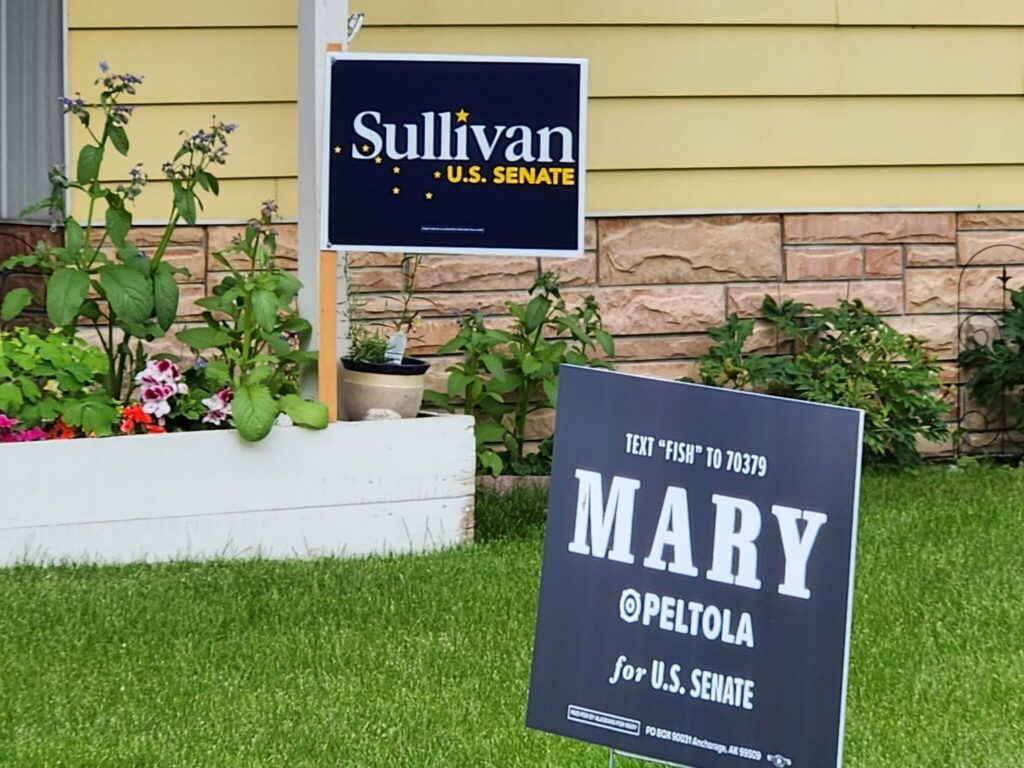
Competing signs in the same Anchorage, Alaska yard, seen Aug. 7, 2026, support the candidates for U.S. Senate in Alaska: incumbent Dan Sullivan, a Republican, and challenger Mary Peltola, a Democrat. (Photo by Yereth Rosen/Alaska Beacon)
The U.S. Department of Justice is stepping up its legal campaign over the midterm elections, suing Alaska over its U.S. Senate election and appealing a lawsuit against suspected noncitizen voters in California.
Election law experts have cast doubt on the strength of the cases, criticizing them as performative.
The Justice Department sued Alaska election officials late Thursday in a preemptive attempt to stop the state from certifying the results of its Senate election if, under the state’s ranked-choice voting method, the Republican incumbent loses by a smaller margin than the votes earned by another candidate of the same name.
Separately, the Justice Department appealed to the 9th U.S. Circuit Court of Appeals a lawsuit seeking to prevent California election officials from counting the ballots of approximately 20,000 voters it says are likely noncitizens unless they can prove their citizenship. The DOJ had demanded a district court decision by Thursday.
Collectively, the Justice Department’s actions signal an expanding legal effort to assert authority over voting as Election Day approaches. President Donald Trump faces political peril in the midterms, with Democrats all but certain to launch investigations into his administration if they retake the House or Senate.
The Trump administration’s past attempts to influence how states run elections largely failed, with the U.S. Supreme Court blocking proposed restrictions on mail ballots and federal judges dismissing DOJ lawsuits to obtain states’ sensitive voter data. But in the waning days before the midterm elections, federal officials are again ramping up election-related activity.
Another Dan Sullivan suit
The Alaska lawsuit came hours after U.S. Attorney General Todd Blanche refused to rule out efforts to block states from certifying their elections. Speaking to reporters after an unrelated event in Virginia, Blanche said it wasn’t the DOJ’s intention to “improperly interfere” with election certifications even as he left room for his department to act.
“I mean, is there any scenario? Yes, of course there’s scenarios that we could all come up with, hypothetically, you know, some doomsday scenario, for example, right?” Blanche said.
The Alaska Division of Elections and the Justice Department didn’t immediately respond to requests for comment.
In the Alaska Senate race, Republican Sen. Dan S. Sullivan and his supporters have cast Dan J. Sullivan, also a Republican, as a spoiler in a competitive race against Democrat Mary Peltola.
State officials initially kept Dan J. Sullivan off the August primary ballot but the Alaska Supreme Court overturned the decision. He finished third, with 2.5% of the vote, qualifying for the four-way general election.
Trump had previewed a possible lawsuit earlier in the week. On Truth Social, the president on Wednesday called the Senate race in Alaska “totally confusing” and slammed Dan J. Sullivan’s presence.
“We are looking at powerful legal options to remove the fraudulent Daniel J. Sullivan Jr. from the Ballot, and holding the Democrats accountable for their Election Interference, in the pursuit of Justice and Fairness,” Trump wrote.
Experts skeptical
Early expert reaction to the Justice Department’s complaint has been sharply critical. The complaint cites the preamble of the National Voter Registration Act, which says one of its purposes is “to protect the integrity of the electoral process.”
Writing in Election Law Blog, Derek Muller, a professor of law at the University of Notre Dame focused on elections, called the legal argument “one of the worst ones I’ve ever seen.”
“Some, in a panic, might react that the Department is trying to deny certification of an election in a state. Of course that’s what the Department is trying to do. But the legal claim is so absurdly thin, there’s essentially no likelihood of success,” Muller wrote.
California noncitizen case appealed
In California, Assistant U.S. Attorney Julie Hamill filed a notice of appeal in the Justice Department’s lawsuit over alleged noncitizen voters just three days after the the DOJ requested a temporary restraining order to halt ballot counting for individuals on the list of 20,000.
Hamill wrote that the DOJ was interpreting U.S. District Court Judge David Carter’s silence as a denial of its request.
Carter, an appointee of President Bill Clinton, had only taken on the case a day earlier and had set a hearing for Oct. 27. Earlier this year, he became the first federal judge in the country to rule against the Justice Department’s lawsuits attempting to force states to turn over sensitive voter data.
On Friday, the Justice Department filed a new motion asking Carter to block the ballot counting and requested a ruling by noon Pacific time.
In that filing, Hamill wrote that “every minute” of ballot processing that occurs without setting aside ballots of suspected noncitizens dilutes the votes of U.S. citizens.
Case ‘exceedingly weak,’ critics say
Critics of the Justice Department’s actions argue the time crunch is largely of its own making.
David Becker, executive director of the nonpartisan Center for Election Innovation & Research, noted during a press call Thursday that the DOJ didn’t file its lawsuit until more than a week after California began mailing ballots — and then several more days to seek a temporary restraining order.
“I think this case is exceedingly weak,” said Becker, who worked as a senior trial attorney in the Justice Department’s Voting Section during the Clinton and George W. Bush administrations.
Attorneys for California Secretary of State Shirley Weber, a Democrat, and Los Angeles Registrar-Recorder/County Clerk Dean Logan have both asked Carter to dismiss the lawsuit.
Logan’s legal team on Wednesday wrote that Los Angeles County hasn’t changed how it conducts elections. What’s changed, they wrote, was the federal government’s posture.
“Weeks before Election Day, the United States asks this Court to intrude on the administration of an election,” Logan’s lawyers wrote.