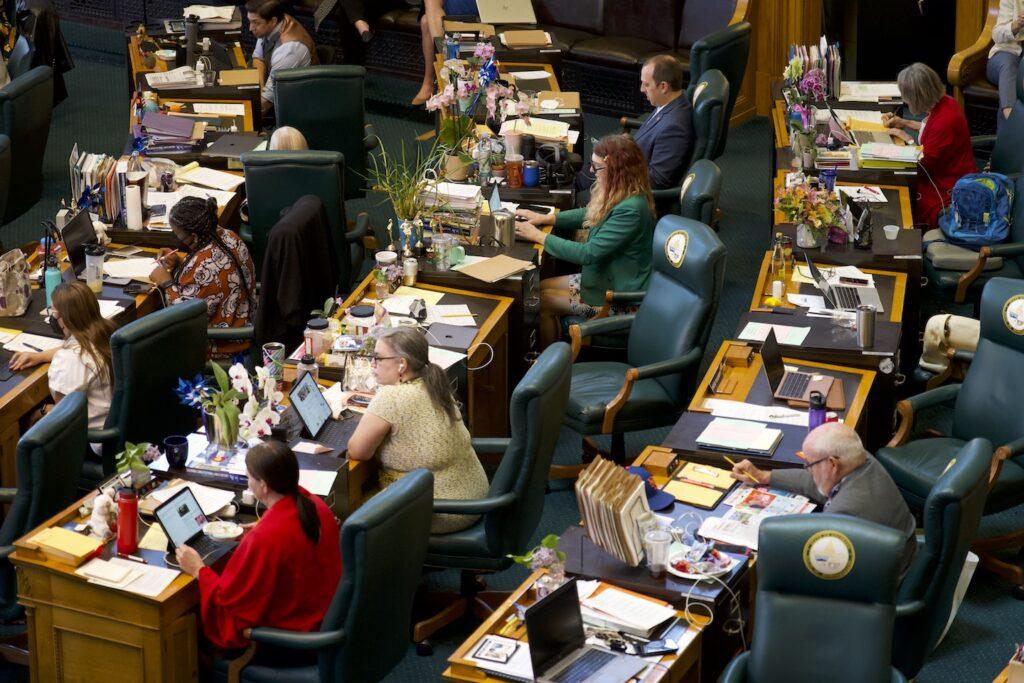
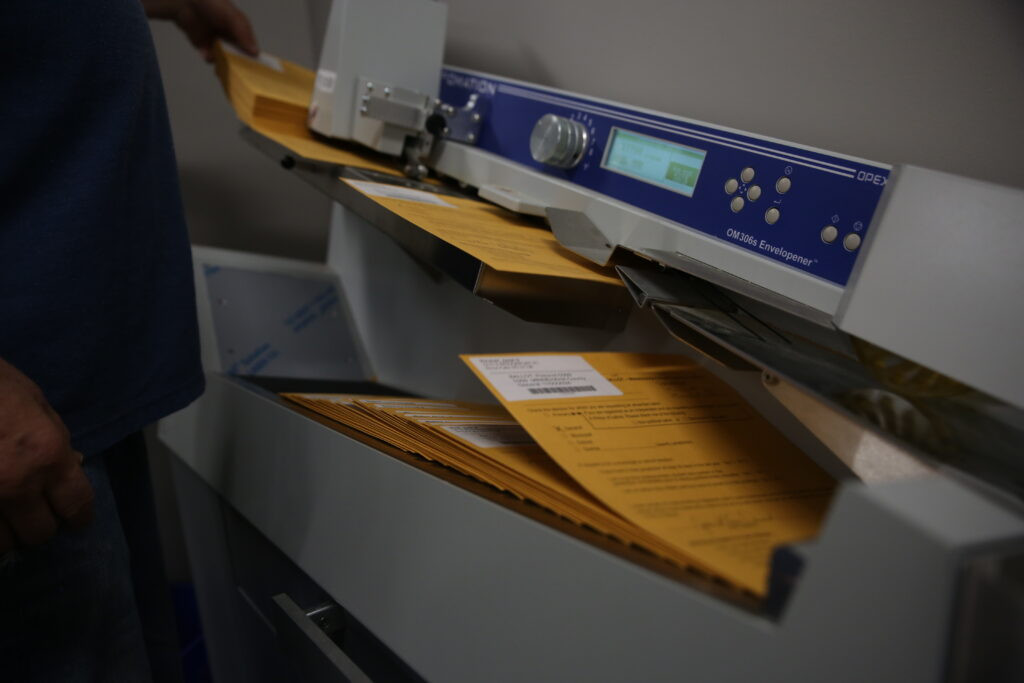
Election workers use a machine to process absentee ballot envelopes for Minnehaha County, South Dakota, on Nov. 5, 2024, in the county administration building. (Photo by Makenzie Huber/South Dakota Searchlight)
Byron Sutter has been voting by mail for years, ever since he worked in healthcare and couldn’t leave his patients to vote in person.
Mary Ann Klarenbeek votes by mail because she has breathing problems and can’t stand in line at a polling place.
John Jeratowski travels for work as a journeyman electrician and would have to surrender pay to go home and cast his ballot if he couldn’t vote by mail.
Trump drops longtime aversion to mail-in voting with GOP trailing in polls
Dorian Miller has been spending more time with grandkids in Texas than she expected, leaving mail-in voting as her only option to cast a ballot in South Dakota when she’s 1,100 miles from home.
They’re some of about 5,700 people who have voted by mail so far in the runup to South Dakota’s Nov. 3 general election. Mail-in voters account for 13% of advance ballots cast in the state at this point, with the rest coming through in-person voting, authorized messengers, or special accommodations for overseas and military voters.
President Donald Trump has alleged “mail-in ballots are inherently corrupt,” despite voting by mail himself. He tried to impose new regulations on mail-in voting, but the U.S. Supreme Court blocked him last month.
South Dakota Searchlight recently purchased a list of advance voters from the South Dakota Secretary of State’s Office and used it to locate and interview those who cast ballots by mail, including some who agreed to have their voices recorded and posted on Searchlight’s website. Searchlight asked why they vote by mail, why it’s important to them, and what it would mean if mailing their ballots were no longer an option.
Physical limitations, but a sharp mind for voting
https://southdakotasearchlight.com/wp-content/uploads/2026/10/Eva-Rawerts-vignette.wav
Eva Rawerts in her own words.
Eva Rawerts, age 90, voted by mail from a nursing home in Aberdeen.
The registered Republican can’t make it to the voting booth, but said she wants to support the candidates of her choice. Rawerts said she’d be “very despondent” if she were no longer able to vote by mail.
“My mind is very sharp,” Rawerts said, “and I want to vote, and I care what happens to our country.”
Voting by mail for 28 years: ‘It is safe and secure’
When Jeff Odell lived in California, he stood in line for two hours to cast a ballot, he said. He’s been voting by mail ever since.
Odell moved to Lemmon, South Dakota, in 2021. The 58-year-old who’s registered as an independent works in technology sales and isn’t always able to make it to the polls on Election Day.
“I’ve been voting by mail since I was 30, and it’s so much more convenient,” Odell said. “Regardless of what the president rambles about, it is safe and secure. In South Dakota, you have to provide so much documentation to even register to vote.”
If voting by mail was restricted to some degree, Odell said, “it would be a shame.”
“I could see it happen for pure political reasons, but I think it’d be a bad move overall,” Odell said. “South Dakota has enough rules and regulations around what it takes to mail-in vote. I think there’s plenty of safety in there.”
More time to digest a long ballot
https://southdakotasearchlight.com/wp-content/uploads/2026/10/Alexander-Campbell-Vignette.wav
Alexander Campbell in his own words.
Alexander Campbell is 21 years old and said he’s only ever voted by mail. Originally from Virginia, the registered Democrat moved to South Dakota this year to live and teach in Mission.
“Voting by mail is important to me because it allows you to sit at home and digest the long ballot,” Campbell said. “It also allows you to make sure that your vote is in early, so that way you don’t have to deal with an emergency on Election Day.”
But South Dakota has many barriers that can make it difficult to vote in rural and tribal areas of the state, Campbell said. South Dakota does not have online voter registration, for example, like Virginia does.
“I was pretty shocked at the level of difficulty,” Campbell said.
In healthcare, ‘you can’t just walk away from your job’ to vote
https://southdakotasearchlight.com/wp-content/uploads/2026/10/byron-sutter-vignette.wav
Byron Sutter in his own words.
Byron Sutter of Rapid City said he started voting by mail about two decades ago when he and his wife worked at a Rapid City hospital and struggled to step away to vote on Election Day. Sutter said he worked mostly in intensive care units caring for ventilator patients.
“We were in direct patient care. You can’t just walk away from your job, and oftentimes we were short-staffed,” Sutter said. “I know employers are supposed to allow employees to go vote, but the reality of it is that it just does not work out sometimes, especially in acute healthcare.”
Sutter has continued to use mail voting at 81 years old, rather than going to a polling place.
“A lot of times, we’d be standing in line for a relatively long period of time,” Sutter said, adding that while filling out his ballot at home, he doesn’t “feel pressured to hurry up” so someone else can vote behind him at a polling place.
In recent years, though, after receiving his ballot by mail, Sutter has chosen to drop his completed ballot off at his county auditor’s office rather than rely on the Postal Service to return it.
“I feel like it’s a little more secure — a little less chance of somehow the ballot being misplaced or whatever,” Sutter said.
1,100 miles from a polling place
https://southdakotasearchlight.com/wp-content/uploads/2026/10/dorian-miller-vignette.wav
Dorian Miller in her own words.
On Election Day, said Dorian Miller, she will be 1,100 miles from her South Dakota polling place.
The 78-year-old registered Democrat was born and raised in Marion, but said she spends a lot of time in Texas to be close to her children, grandchildren and great-grandchildren.
She said traveling back to South Dakota to vote, especially in the winter, would be difficult, so she votes by mail.
“I started out as a winter Texan and had no intention of being here this much, but as time went by, things happened,” Miller said. “I’m a resident of South Dakota, and I have a lot of family there.”
Voting by mail saves journeyman electrician from missing pay
https://southdakotasearchlight.com/wp-content/uploads/2026/10/john-jeratowski-vignette.wav
John Jeratowski in his own words.
John Jeratowski never knows where he’ll be on Election Day. The 44-year-old Republican from Egan works as a journeyman electrician, often working away from home.
He votes by mail because he isn’t typically home for in-person advance voting on weekdays when the county auditor’s office is open.
“It’s not only convenient, but necessary for me,” he said.
If he wasn’t able to vote by mail, he said, he’d have to take unpaid time off work.
“I would end up having to lose a good amount of money just to come back on Election Day to vote in person,” he said.
Disabilities keep couple from the polls
https://southdakotasearchlight.com/wp-content/uploads/2026/10/Mary-Klarenbeek.wav
Mary Ann Klarenbeek in her own words.
Mary Ann Klarenbeek and her husband can’t stand in line to vote at the polls, she said. The 84-year-old registered Republican lives in Harrisburg.
“We’ve got breathing problems, and our legs don’t move like they used to,” Klarenbeek said. “And my husband has heart problems, so that’s why it’s important for us to vote by mail.”
If the two lost the ability to vote by mail, she would “feel really bad.”
“I feel it’s important for everybody to vote, and I feel if you don’t vote, you don’t have any say in anything,” Klarenbeek said.
Snowbirds get ballots before heading south
https://southdakotasearchlight.com/wp-content/uploads/2026/10/jess-hall-vignette-FINAL.wav
Jess Hall in his own words.
Jess Hall won’t be in South Dakota on Election Day. He’ll be at his second home in south Georgia, escaping the northern Great Plains weather.
The 63-year-old Republican is a resident of Winner. He and his wife request mailed absentee ballots before they head south for the winter.
Hall served 20 years in the military and 20 years as a government contractor, so it’s important to him to “take care of our country and make sure it’s going in the right direction that I would like to see happen,” he said. Hall drops his ballot off at the auditor’s office before leaving town, but his wife mails hers.
Hall added that even though he and his wife participate in the mail voting system, he thinks it is “susceptible to fraud.”
“I mean mine’s, you know, legit, but I mean, some of those people, yeah, they’re not,” Hall said. “They’re not legit. So that’s the only part that I don’t like.”
Disabled veteran relies on mail-in voting
https://southdakotasearchlight.com/wp-content/uploads/2026/10/greg-adams-vignette.wav
Greg Adams in his own words.
Greg Adams said he has voted by mail for as long as he can remember — since he served in the military during the Vietnam War, through decades of work travel, and into retirement as a disability has made leaving the house difficult.
The 80-year-old non-politically affiliated voter from Sioux Falls said if he couldn’t vote by mail, he’d figure out how to vote “somehow.” He was not aware that South Dakota allows authorized messengers to deliver ballots for voters if they can’t make it to the polling place.
While he’s heard reports about election “hanky panky” across the country, he said, South Dakota “has safeguards” to ensure elections are secure and that only U.S. citizens can vote.
“I hope that people that have valid reasons for voting absentee get to continue voting absentee,” Adams said. “In South Dakota, it seems safe and like everything is on the up and up, and it’s easy for me to do.”
Would need a ‘carrier pigeon’ without mail-in voting in rural area
https://southdakotasearchlight.com/wp-content/uploads/2026/10/Nicholas-Janis-vignette.wav
Nick Janis in his own words.
Nick Janis is 69 years old, is a registered Republican and lives north of Kyle, which is on the Pine Ridge Reservation. He’s disabled, he said, doesn’t have a driver’s license and doesn’t have a ride to the polls on Election Day.
“I don’t know how I could get to the polls to vote, because I live in the country. I’ve got to drive on a dirt road for 7 miles, or 5 miles of gravel before I even see pavement,” said Janis, a member of the Rosebud Sioux Tribe.
He added that November weather in south-central South Dakota can be unpredictable. He’ll sometimes be snowed in for weeks at a time or lose electricity.
Janis joked that he’d need a “carrier pigeon” if mail-in voting wasn’t an option. He did not know some voters can use authorized messengers if they’re unable to vote in person, but he said it wouldn’t be realistic for him.
“Nobody would know where to find me out here,” he said. “They’d get lost.”
He dismissed concerns about mail-in voting fraud as “dumb,” citing South Dakota’s safeguards.
“You have to be a citizen, you have to be that to get signed up to vote by mail,” Janis said. “You have to show your picture ID and describe where you live and all that just to vote by mail.”
Trucker says voting by mail is convenient for work schedule
https://southdakotasearchlight.com/wp-content/uploads/2026/10/ted-otten-vignette.wav
Ted Otten in his own words.
Ted Otten, 64, is a Democrat. He lives in Aberdeen, but is often on the road as a long-haul truck driver. Otten has been voting by mail for decades, he said, because it gives him time to review what’s on the ballot.
“If I lost the ability to mail in my vote, first of all, then there’s something wrong with our system, and there would be a type of suppression going on,” he said. “I would be, also, very restricted in my time to vote, though I will still vote.”
Disability limits travel to polls: ‘What other alternative do many of us have?’
https://southdakotasearchlight.com/wp-content/uploads/2026/10/jacki-omland-vignette.wav
Jacki Omland in her own words.
Jacki Omland, a 70-year-old Democrat, had a fall in 2022 that left her unable to leave her home in Aberdeen.
She’s been voting by mail since then, with help from her husband, who makes sure her ballot gets returned.
“Some of us have to do it,” Omland said. “I mean, what other alternative do many of us have?”
If she lost the ability to vote by mail, Omland said, “it would be devastating.”
“For other things for handicapped people, they make arrangements for us,” Omland said. “One of the primary things we have in our life is voting. And so why take that away from me just because I’m handicapped?”
Former election worker receives ballot by mail
https://southdakotasearchlight.com/wp-content/uploads/2026/10/Shaun-Feilmeier-vignette.wav
Shaun Feilmeier in his own words.
Shaun Feilmeier, 42, is registered as an independent and lives in Sioux Falls. He used to serve as a deputy auditor in Lincoln County, a job that included helping to run elections. Because he was always busy on Election Day, the job “necessitated” voting early.
His time in the office was stressful because it overlapped with “the election-denying craze,” Feilmeier said, referring to people who agitated for election policy changes in the wake of President Trump’s false claim that he won the 2020 presidential election.
“I was literally followed home and threatened by some of these election deniers,” Feilmeier said. “That’s what really started a lot of this stress, was the insanity of that time, and I don’t really see it going away. It’s just changing its face.”
Feilmeier receives his ballot by mail but returns it to the county auditor’s office himself to make sure it gets counted.
He said all forms of mail-in voting are secure, though, and “should be encouraged.”
“A lot of people that couldn’t or wouldn’t otherwise get to the polls can vote or will vote, and we need more people to vote,” he said. “Making it easier and more convenient to vote is a good thing, especially since we know how to do it in a secure way.”
Retiree says winter travel shouldn’t restrict his vote
Wayne Halma travels from Sioux Falls to Arizona to escape the Midwest winters. But the 78-year-old Republican still votes in South Dakota elections by mail. Without that opportunity, he said, “then my voice is not heard.”
“My home base is South Dakota, so I would expect to vote as a South Dakotan,” Halma said.
It’s “hard to believe” accusations that mailed-in votes in South Dakota could be fraudulent, he said, because of state laws that require a photocopied ID or notary seal for mail-in voting.
“The safeguards they have in place, just the type of people that we are here, I don’t see a push for any of that type of election fraud,” Halma said. “I think South Dakota in general is above board on everything as far as voting.”