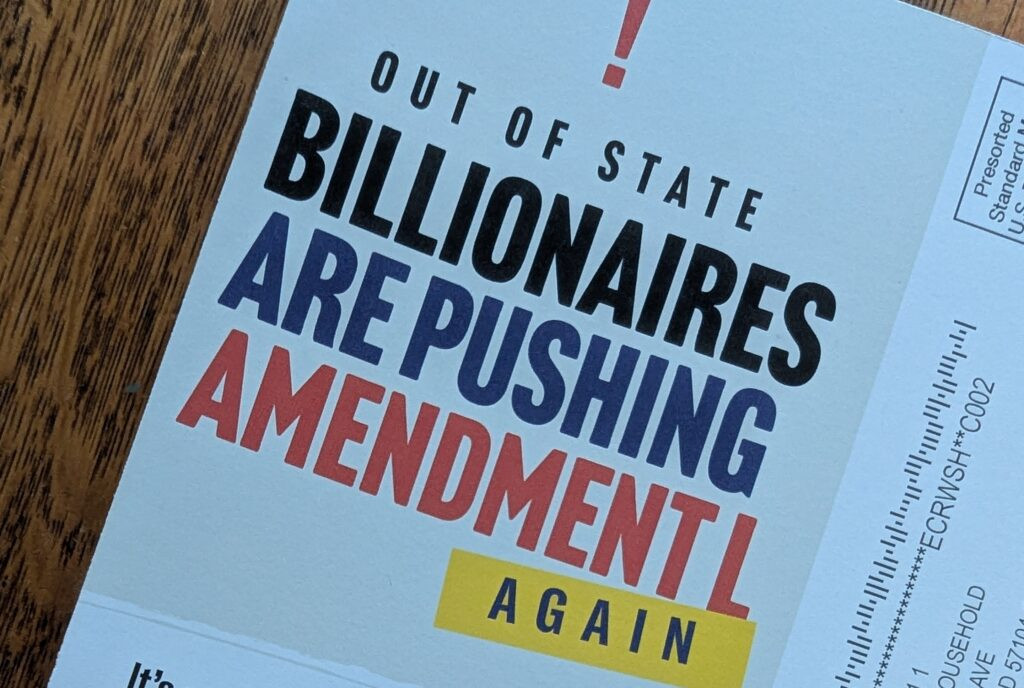
Mailed campaign materials from L-No, a South Dakota ballot question committee formed to opposed a measure that would require 60% voter approval to change the state constitution. (Photo by John Hult/South Dakota Searchlight)
https://southdakotasearchlight.com/wp-content/uploads/2026/10/Amendment-L-campaign-finance-web.wav
Listen to an audio version of this story produced by reporter Meghan O’Brien. Broadcasters: See below for a downloadable version with a host intro script.
Groups opposing a higher bar for approving state constitutional amendments have so far outspent supporters of the ballot question by nearly $2 million, according to campaign finance reports filed this week.
L-No, a state-level ballot question committee formed to defeat the proposal, has raised over $2.2 million — primarily from a Washington, D.C.-based nonprofit called The Fairness Project — and spent $1.7 million. The Fairness Project has independently spent an additional $260,000 against the ballot question.
Meanwhile, the Save our South Dakota Constitution committee has raised about $93,000, including a last-minute infusion from a federal political action committee connected to U.S. Senate Majority Leader John Thune, R-South Dakota, and spent about $11,000.
Fundraising and spending will continue through Election Day, and there are no limits on contributions to ballot question committees.
Hear pro and con voices on Amendment L in an episode of the Searchlight Report podcast.
The fight is over Amendment L, one of four statewide questions on South Dakotans’ Nov. 3 general election ballot. It deals with the process for gaining voter approval for state constitutional amendments.
Lawmakers can place amendments on the ballot, and so can citizens if they collect enough petition signatures from registered South Dakota voters. Amendments currently need a simple majority from voters to pass, but Amendment L would change the threshold for future amendments to 60%.
Supporters of Amendment L say it will protect the constitution from policies that don’t belong in it, and preserve fundamental elements like the structure and function of government.
Opponents allege Amendment L — which was placed on the ballot by the Republican-dominated Legislature — is an attempt by Republican lawmakers to block voters from adopting policies like Medicaid expansion, which voters put in the constitution four years ago, or abortion rights, which petitioners have unsuccessfully attempted to place in the constitution.
“The stakes are high,” said Rep. John Hughes, R-Sioux Falls, a member of the Save our South Dakota Constitution committee and the sponsor of the legislative resolution that put Amendment L on the ballot.
National, state contributors back L-No
The Fairness Project contributed nearly $1.7 million to the L-No committee, and the organization has also spent $260,000 independently, raising its total effort against Amendment L to nearly $2 million.
The nonprofit, which does not disclose its donors, has spent millions of dollars to support ballot measures that protect abortion rights across the country, including Florida, Missouri, Montana and Nebraska. The group has also backed other initiatives, including Paid Sick Leave for Nebraskans and Protect Majority Rule, a Missouri group that opposed raising the bar for passing statewide ballot initiatives.
The group has helped more than 40 ballot measures succeed, according to an emailed statement provided to Searchlight by Executive Director Hannah Ledford.
“Those wins have improved the lives of more than 23 million people,” Ledford said. “Our work is rooted in a simple principle: Power belongs with the people, and when politicians fail them, they can take matters into their own hands.”
Other major contributors to L-No include the National Education Association, which pitched in $500,000, and the South Dakota Education Association, with a $100,000 contribution.
Approving Amendment L would invite more “big money” into South Dakota campaigns, said Ryan Rolfs, executive director of the South Dakota Education Association, in a written statement to Searchlight. A higher bar for constitutional amendments, he said, “leaves only the best-funded interests able to clear it.”
“This isn’t about any one issue,” Rolfs said. “It’s a permanent change to the rules for every future decision, including those that affect our schools.”
Similar attempts to raise the threshold for voter approval of ballot questions have been rejected by voters in past elections. In 2018, voters defeated Constitutional Amendment X, which would have raised the approval requirement for constitutional amendments to 55%. Constitutional Amendment C failed in 2022. That measure would have required 60% voter support for ballot questions that increase taxes or fees or require the state to spend $10 million or more in a measure’s first five years of implementation.
“The people of South Dakota don’t want this, and that’s been very, very apparent,” said John Fiksdal, who works with L-No.
The American Cancer Society Cancer Action Network has independently spent about $11,500 on advertising against Amendment L. A spokesperson for the organization said it wants to help preserve the ability of citizens to pass constitutional amendments such as expanded Medicaid coverage, which passed with 56% of the vote in 2022.
Thune-affiliated committee helps pro-Amendment L group
Save our South Dakota Constitution, the committee organized to support Amendment L, has received about $53,000 from individuals and groups in the state, according to campaign filings.
The rest of the committee’s income is from Heartland Values PAC, according to a Wednesday filing by the ballot committee, listing a $40,000 contribution. The PAC is affiliated with Thune.
The largest personal contribution is $25,000 from Kathy Sullivan, whose address is listed as a Sioux Falls post office box. A nearly $11,000 donation came from Jerald Berg, a Sioux Falls resident. Searchlight was not able to reach either of them for comment.
Other contributions include $5,000 from South Dakota Right to Life PAC.
Rhonda Milstead, who runs the ballot question committee, said Washington, D.C., donors to Amendment L’s opponents “don’t belong in South Dakota.” She said the state’s current simple majority requirement is too easy to clear for campaigns with enough funding.
“But 60%, whether it’s good or bad for either side, 60% means that it has to be more people that get involved in it,” Milstead said. “If you are passionate, if it’s the right thing to do, you darn well better get 60%. And if you can’t get 60%, you don’t belong in the game.”