
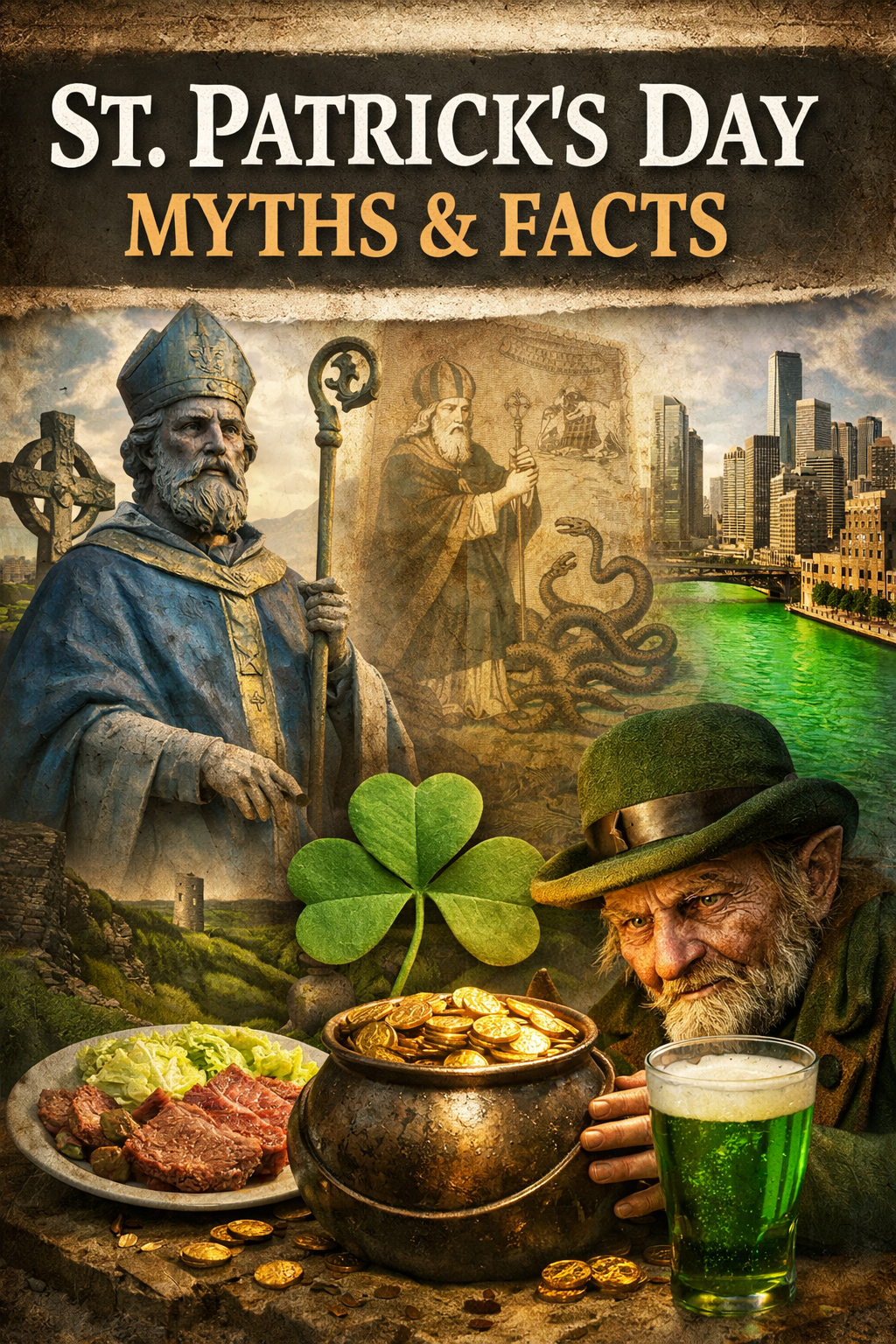
Every March 17th, the same things happen. People put on green, bars run specials, someone dyes a river, and somewhere a sign gets printed with the words “Happy St. Patty’s Day” on it. That last one is wrong, by the way, and we’ll get to it. But first, here’s what most people celebrating this holiday don’t know: almost everything you think you know about St. Patrick’s Day is either a myth, an American invention, or a story that got a lot more interesting somewhere along the way.
The holiday has been observed for over 1,500 years. In that time, it’s traveled from a cold hillside in Roman Britain to the streets of Tokyo, picked up a few legends about snakes that never existed, and somehow become one of the most celebrated days on the planet for people who have never set foot in Ireland. That’s a pretty remarkable journey for a feast day that, until 1970, didn’t even allow alcohol in the country it was named for.
The Man Wasn’t Even Irish
Let’s start at the beginning. St. Patrick, the patron saint of Ireland, was born in Roman Britain, somewhere around 385 AD in what is now Scotland or Wales. His given name was Maewyn Succat. He wasn’t Irish, didn’t grow up there, and had no particular reason to have any connection to the island at all.
That changed when he was about 14. Irish raiders kidnapped him, brought him across the water, and put him to work as a shepherd for six years. Cold, isolated, and far from home, he became deeply religious. He eventually escaped, made his way back to Britain, spent years studying for the clergy, and then did something that, depending on your perspective, is either profoundly faithful or almost incomprehensible. He volunteered to go back. Back to Ireland. Back to the place that had enslaved him. He spent the rest of his life there as a missionary.
The man we celebrate every March 17th was a kidnap survivor from Britain who returned to his captors’ homeland by choice. That story alone is more compelling than anything you’ll find printed on a party napkin.
Ireland Banned Alcohol on St. Patrick’s Day
Here’s the one that tends to stop people mid-sip. For the better part of the 20th century, Ireland treated March 17th as a religious feast day, which meant the bars were legally required to close. This wasn’t a brief experiment. The law was on the books from 1903 all the way until 1970.
The rowdy, pub-heavy, green-beer-soaked version of St. Patrick’s Day that the world knows is almost entirely an American creation. Irish immigrants in cities like Boston and New York, many of them desperately poor and struggling to find acceptance in a new country, transformed the feast day into a celebration of identity and survival. The parades grew bigger. The traditions got louder. And the whole thing eventually sailed back across the Atlantic and convinced Ireland itself to loosen up.
So the next time someone tells you to celebrate St. Patrick’s Day the “authentic Irish way,” you can let them know the authentic version involved mass in the morning and tea in the afternoon. You’re welcome.
It’s Paddy. Not Patty.
This one matters, and not just as a trivia footnote. Every year, stores, brands, and well-meaning people everywhere plaster “Happy St. Patty’s Day” across everything from banners to social posts. And every year, Irish people wince.
Patrick in Irish is Padraig. The nickname that comes from Padraig is Paddy, with two D’s. That’s where it comes from, rooted directly in the Irish language. Patty is a nickname for Patricia. It’s a different name entirely. The two words aren’t interchangeable, and one of them is just incorrect.
There’s even a website dedicated to this exact issue, paddynotpatty.com, that has been making the case for years with a simple argument: if someone spelled your name wrong on your birthday in giant letters every single year, you’d notice. Getting it right costs nothing and means more than you’d think.
St. Patrick’s Color Was Blue
Here’s a quick one to pull out at a party. The color most commonly associated with St. Patrick himself wasn’t green. It was a soft, muted shade of blue now known as St. Patrick’s Blue, which appeared on old Irish flags, royal coats of arms, and presidential seals going back centuries.
Green took over gradually during the 18th and 19th centuries, driven largely by political movements and the powerful symbolism of Ireland’s landscape. The Emerald Isle nickname didn’t hurt. Eventually green absorbed everything, including the whole tradition of wearing it on March 17th or risk getting pinched, which is itself an almost entirely American invention based on the idea that green made you invisible to leprechauns.
The original color. The wrong spelling. The dry pubs. The holiday has a habit of being almost nothing like what most people picture.
The Shamrock Was a Teaching Tool
The story most people know is that Patrick used the three-leaf shamrock to explain the concept of the Holy Trinity to the Irish people he was trying to convert. Three leaves, one plant. Simple, visual, memorable. Good teaching.
What’s less remembered is that the original symbol associated with Patrick wasn’t the shamrock at all. It was the snake. According to legend, he drove every snake in Ireland into the sea after a 40-day fast on a hilltop. The problem is that Ireland never had snakes. The island separated from Britain before they could migrate there naturally after the last Ice Age.
Most historians believe the snake story is symbolic. In early Christian tradition, snakes often represented paganism and the old religions. Driving out the snakes almost certainly meant converting the island and pushing out the beliefs that preceded Christianity. The shamrock came later as the more enduring image, and it turned out to be a much better logo.
Chicago’s Green River Started as a Sewage Inspection
Every year, the city of Chicago dyes the Chicago River green for St. Patrick’s Day. It’s become one of the most iconic images of the holiday anywhere in the world. The origin story, though, is a little less poetic than the result.
In 1962, a city worker named Stephen Bailey was using a special fluorescent dye to trace illegal sewage dumping in the river. The dye was orange, but in the water it turned a vivid, unexpected shade of green. Bailey mentioned it to his father-in-law, who happened to be organizing that year’s St. Patrick’s Day parade. The following year, they dumped 100 pounds of the stuff into the river on purpose.
That first batch kept the river green for a week. Today they use far less and keep it to a few hours. The exact formula is a closely guarded city secret, which honestly just makes the whole thing better. Every year, Chicago has a secret river recipe. That’s a great city.
Argentina Has One of the Biggest Celebrations on Earth
When people picture the world’s great St. Patrick’s Day celebrations, Buenos Aires probably isn’t the first city that comes to mind. It probably should be.
Argentina goes enormously for this holiday, with tens of thousands of people filling the streets of Buenos Aires every year for what locals call St. Patrick’s Week. The connection runs deeper than most people realize. During the 19th century, a significant wave of Irish immigrants settled in Argentina, many of them fleeing the Great Famine. They brought their culture with them, and over generations it wove itself into Argentine life in a way that stuck. There’s even a town in the province of Buenos Aires called Capitan Sarmiento with strong enough Irish roots that it still holds traditional celebrations today.
St. Patrick’s Day isn’t just an American export. It’s a story that traveled with people wherever they went, and took root in places you’d never expect.
Tokyo Does It Bigger Than Most
Tokyo has been holding an official St. Patrick’s Day parade since 1992. Called the I Love Ireland Festival, it runs through the Omotesando neighborhood and draws tens of thousands of people. There’s no significant Irish immigrant community driving it. Japan simply liked the holiday and adopted it, fully and enthusiastically, with Irish dancers, bagpipers, people dressed head to toe in green, and businesses and schools getting involved.
There’s something genuinely moving about that. A holiday so tied to a specific culture and a specific island that it crossed every ocean, every language barrier, and every logical reason to stay contained, and landed in Tokyo because people there thought it looked like something worth celebrating.
The World’s Shortest Parade
On the opposite end of the scale from New York’s parade, which draws nearly two million spectators and has been running since 1762, there’s a town in County Cork, Ireland called Dripsey. For years, Dripsey hosted what was recognized as the world’s shortest St. Patrick’s Day parade. The entire route was 100 yards long and ran between the town’s two pubs.
Start at one pub. Walk 100 yards. End at the other pub. The Dripsey parade understood something the big productions sometimes lose sight of. The destination matters. Somebody in a small Irish town looked at the whole concept and engineered the most efficient possible version. It drew international media attention. It was perfect.
What It’s Actually About
Underneath all the green and the noise, St. Patrick’s Day is a story about people holding onto something when they had very little else. Patrick carried his faith back to the island that had taken his freedom. Irish immigrants in America carried their culture to a country that put up signs reading “No Irish Need Apply” and still marched down the street anyway, bigger and louder every year, until the city politicians noticed and wanted to join.
The parade became defiant before it became festive. The holiday became global because the people who kept it alive traveled, and they brought it with them everywhere they went, to Boston and New York and Buenos Aires and Tokyo and a 100-yard stretch of road between two pubs in Cork.
That’s what a real holiday does. It doesn’t stay put. It moves with people, picks up new meaning, and somehow keeps the original feeling at its center.
So this March 17th, raise something. Spell it right. And maybe impress somebody with a story they haven’t heard before.


