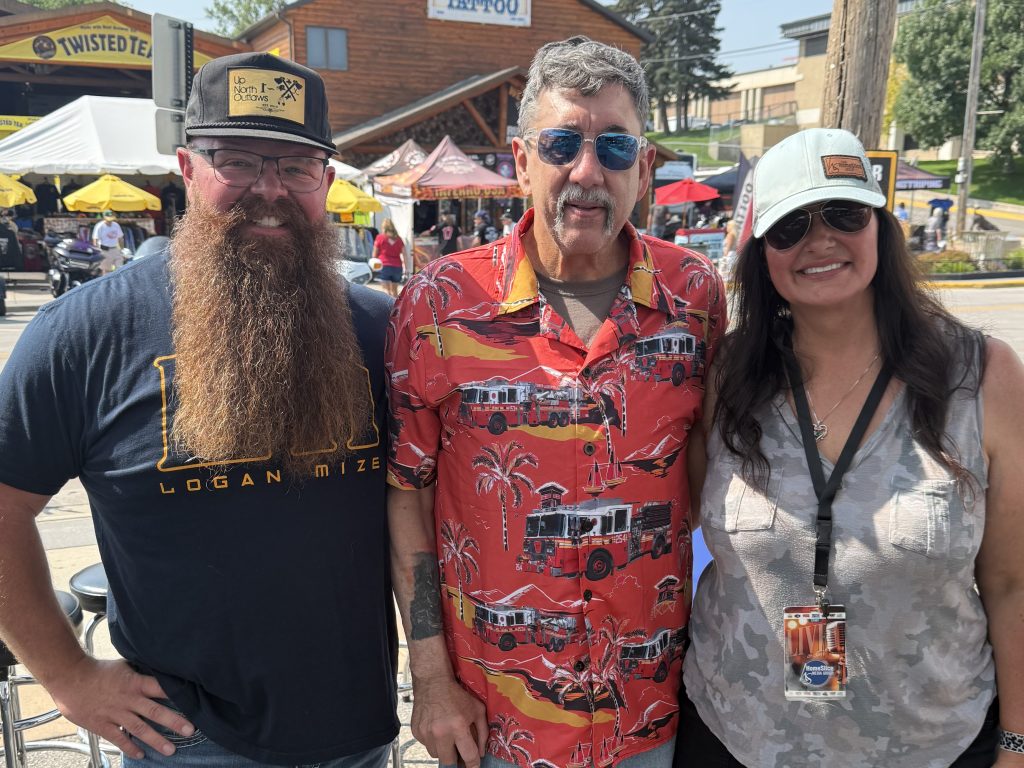
STURGIS, S.D. — Twenty-five years after riding his motorcycle toward the World Trade Center as New York City was under attack, retired FDNY firefighter Tim Duffy is sharing his story in the Black Hills as a grand marshal of the Sturgis Motorcycle Rally. For Duffy, the recognition is something he accepts with humility. “It’s actually an honor to be here,” Duffy said. “And I’m humbled as can be. And just an exciting time for the family.”
Duffy was off duty on the morning of Sept. 11, 2001, and working on his motorcycle at his home near the Verrazzano-Narrows Bridge when he heard a loud boom. He initially thought the sound came from New Jersey, but within seconds, sirens began filling the air. His wife called and told him a plane had struck the World Trade Center. From his kitchen window, Duffy could see the North Tower burning. While still on the phone with his wife, he watched the second plane strike the South Tower. At that point, Duffy knew he was going to work.
Duffy put his motorcycle back together, grabbed his FDNY gear and headed toward his firehouse in Coney Island. There, he found one of his best friends, Jimmy, on the phone with his sister, who was trapped inside the South Tower. Jimmy told her to remain where she was, keep smoke from coming under the door and wait for firefighters to reach her. Minutes later, they watched the South Tower collapse.
Duffy said Jimmy took off toward Manhattan, and he followed on his motorcycle. Before leaving, Duffy’s boss warned him about what firefighters were about to face. “He grabbed me by both my shoulders and told me, ‘Duff, stay with me. Today we’re going to lose hundreds of men,’” Duffy recalled.
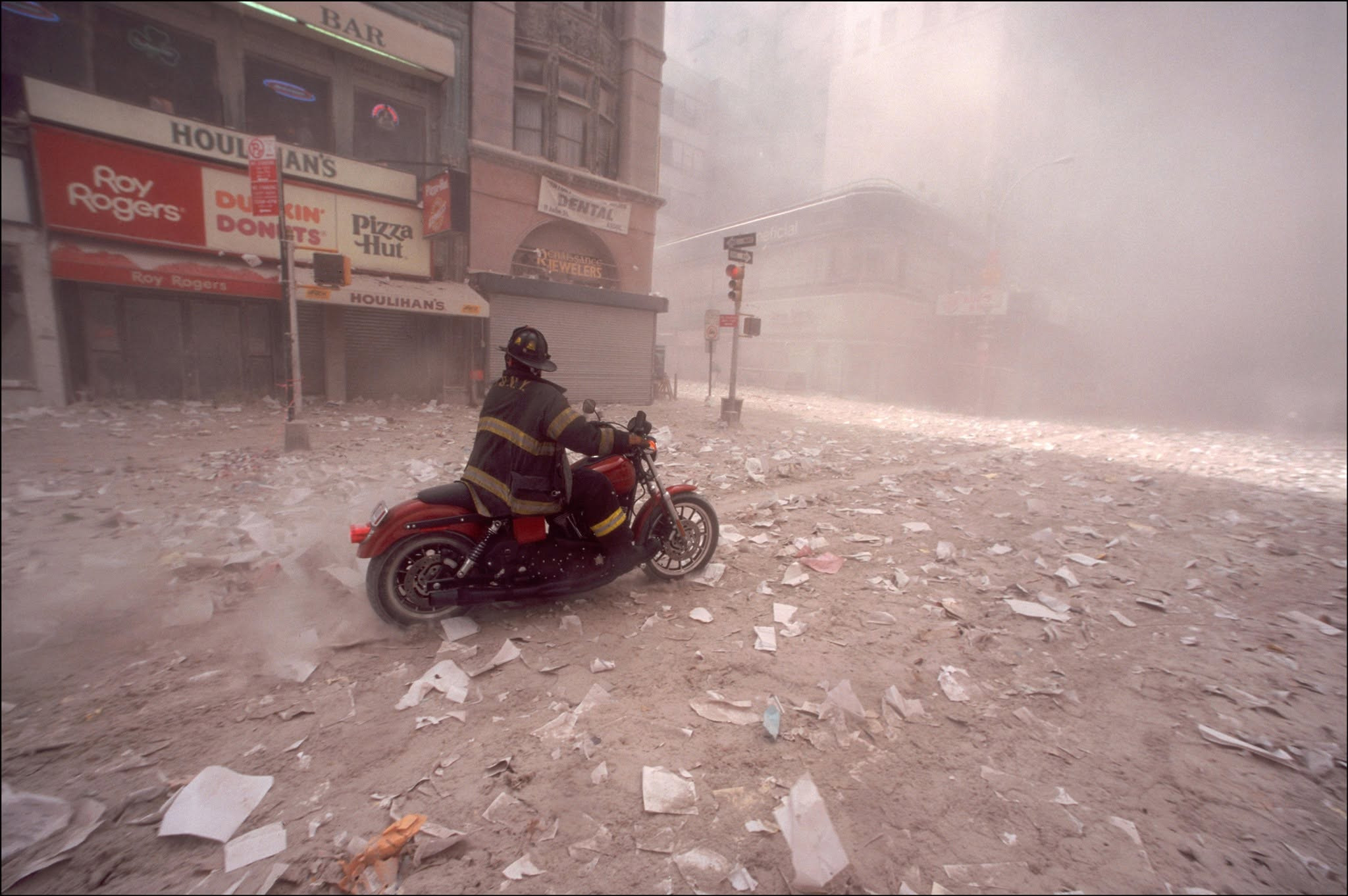
A photograph taken by photographer Allan Tannenbaum captured Duffy riding his 2000 Harley-Davidson FXDX Super Glide Sport toward the destruction. The image would eventually become one of the photographs associated with Duffy’s story, but at the time, having his picture taken was the last thing on his mind. Duffy said he was angry when he noticed the photographer because thousands of people potentially needed help.
Duffy eventually reached the area near the World Trade Center and rode his motorcycle into the lobby of the Millennium Hotel, hoping to protect it while he went to work. As he left the motorcycle behind, he noticed a man inside the hotel stop to look at it. When Duffy later glanced back, he saw the stranger pull down a large curtain and cover the motorcycle. “I figured, dude’s gotta be a biker,” Duffy said.
Duffy headed toward the fallen South Tower, believing there could be thousands of people who needed help. He had only gone several steps when he began hearing booming sounds. The ground started shaking, and Duffy realized another collapse was underway.
Debris knocked him to the pavement and began burying him. Duffy curled into a fetal position and grabbed his helmet as the collapse continued around him. His thoughts immediately went to his family. “I remember saying to myself, ‘You selfish bastard, because what you do for a living, your wife has no husband, your kids now have no dad,’” Duffy said. That thought, he said, also pushed him to survive. Unable to stand without being knocked back down, Duffy began crawling. “After the second or third attempt, I said, ‘Crawl, moron, crawl,’” he recalled.
Duffy made his way to shelter near One Liberty Plaza and struggled to breathe as thick dust filled his mouth and throat. He entered a Brooks Brothers store, searched the first and second floors for anyone who might need help and found a package of handkerchiefs, using one to cover his face so he could breathe.
He later encountered another firefighter with breathing equipment and then came across firefighters carrying an injured man with a compound fracture. Duffy and the others initially planned to carry the injured firefighter several blocks to Beekman Hospital because ambulances in the area had been destroyed or were unavailable.
Then Duffy spotted a white four-wheel-drive Toyota pickup sitting abandoned in the road. Remembering advice he had received during his training to always look for a way to improve a bad situation, he checked the vehicle and found the keys still inside.
Duffy commandeered the truck and transported two injured firefighters to the hospital. When he arrived, he found doctors and nurses waiting outside the emergency room, but few patients had reached them. He then drove back toward Ground Zero, hoping to find more people he could transport. Eventually, the truck’s engine seized after dust clogged the vehicle. “That was the morning,” Duffy said. Duffy described the atmosphere that day as “Armageddon,” saying firefighters believed the country was at war and their responsibility was simply to do the job they had been trained to do.
His service continued long after Sept. 11. Duffy said he spent nearly three months working at Ground Zero. The losses remain deeply personal. “I lost almost three dozen friends in the first hour,” he said. “The kids need to know that.”
Duffy, who is also a Navy veteran, later became involved with the Tunnel to Towers Foundation. He had been close with firefighter Stephen Siller, who died on Sept. 11, and said the two attended training together and worked at their first firehouse together.
Duffy’s work with veterans eventually led him to create One Soldier One Dog One Team, an organization that pairs dogs from shelters and foster homes with wounded veterans. He said the number of veteran suicides was a driving force behind the effort. Because the organization has no employees on its payroll and Duffy does not take a salary, he said all donated money can go toward its mission.
Motorcycles have remained a constant throughout Duffy’s story, although they have also nearly cost him his life. Duffy said he was seriously injured in a motorcycle crash nearly two years ago after another driver ran a stop sign. He suffered a broken neck, lost his hearing and had to be flown to a hospital.
Duffy said his connection with Jesse James Dupree of the Full Throttle Saloon helped bring his story to the Sturgis Motorcycle Rally. Duffy had met Dupree through his involvement with veteran causes, and the two developed a friendship. After Duffy’s motorcycle crash, he said Dupree was already working to help get his motorcycle rebuilt before Duffy had even regained consciousness in the hospital.
The famous photograph of Duffy riding toward Ground Zero has also become a fundraising tool. Tannenbaum gave Duffy permission to use the image to raise money for veterans, and Duffy has traveled with it and signed copies in exchange for donations. Despite his actions on Sept. 11 and the recognition that has followed, Duffy remains uncomfortable with one particular word. “I actually cringe when I hear the word hero,” he said. “I’m a survivor. I just did my job.”
Duffy said being selected as a grand marshal at Sturgis is especially meaningful because friends connected to his 9/11 experience traveled to South Dakota to be with him. Among them was a man who rides across the country in memory of his brother, who was killed on Sept. 11, as well as a firefighter who worked alongside Duffy for months at Ground Zero. For Duffy, having their names associated with his is an honor. “I’m a fireman and I did my job,” he said.
Now, 25 years after the attacks, Duffy said telling the story has taken on another purpose: making sure a generation with no personal memory of Sept. 11 understands what happened and what was lost. “Thank you for letting the story be told so the younger generation understands what happened,” Duffy said. “And the sacrifice that was made in the first hour.”