
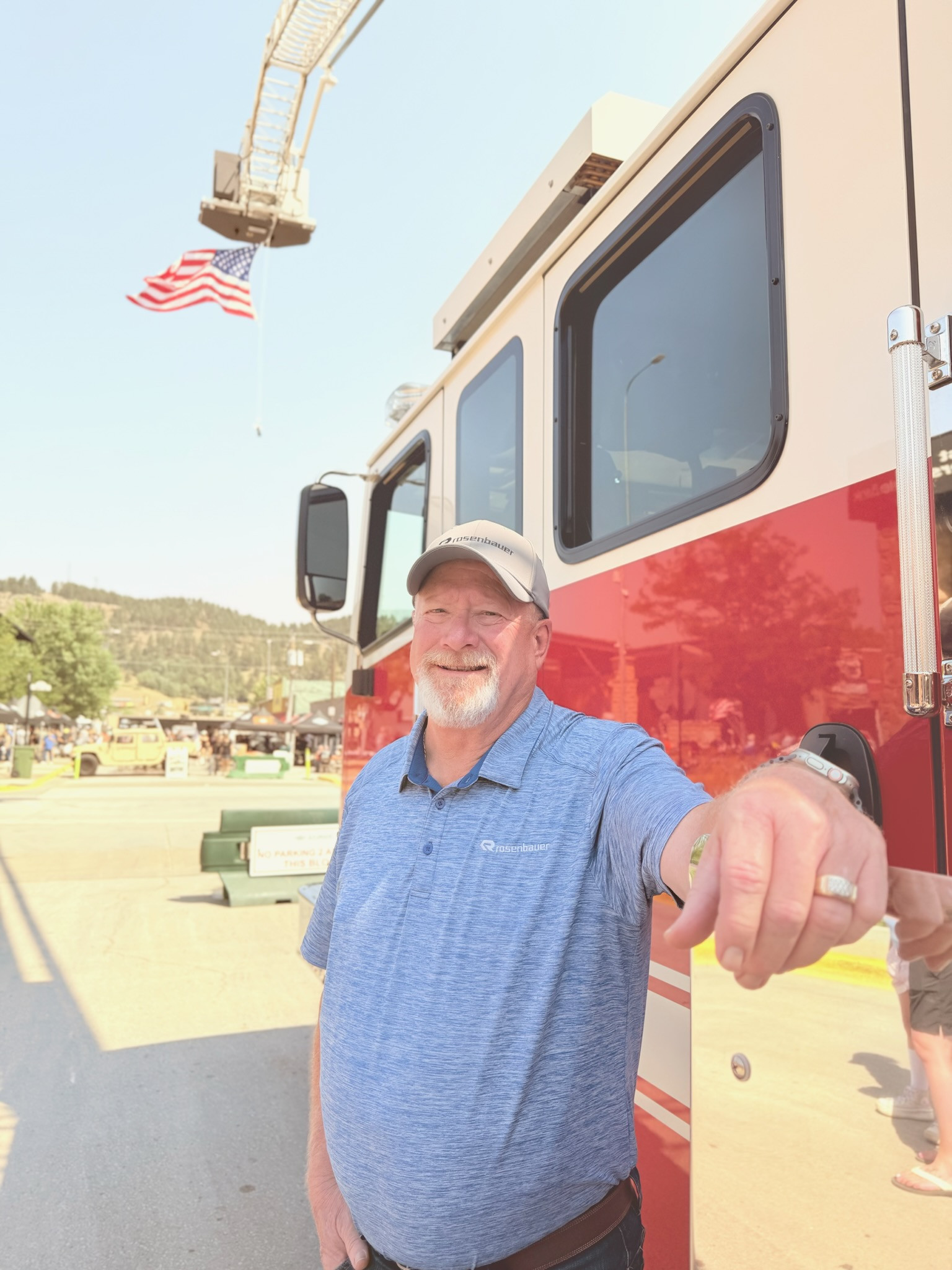
If you’ve wandered past a fire truck parked among the vendor booths and leather stalls during the rally, you weren’t imagining things. Rosenbauer, the company that builds it, has sponsored the Sturgis Motorcycle Rally for almost twenty years, and the story behind that is a lot simpler than you’d guess.
“I’m going to say it started… it’s about nineteen years,” said Roger Parker, Director of Sales for Rosenbauer, who’s been with the company himself for eighteen and a half of those. He sat down with Homeslice Media’s Mark Houston on day five of this year’s rally to talk trucks.
How a Fire Truck Company Ended Up at a Motorcycle Rally
Rosenbauer builds its trucks in South Dakota, and for Parker, that’s reason enough. “We really felt that we’re a South Dakota based company. We build all of our trucks over on the east side of the state, and we wanted to help sponsor Sturgis.” The company already had a relationship with Sturgis Fire, so somebody made a call, somebody said yes, and Rosenbauer’s had a presence at the rally every August since. Half a million people pass through over ten days, so Parker doesn’t need much of a pitch on the exposure.
From a Small Shop in Austria to the East Side of South Dakota
Rosenbauer got its start in Austria in 1866, first as a dealer selling firefighting equipment before it moved into building its own gear. Sometime in the mid-1990s, the company partnered with American manufacturers, which is how Rosenbauer ended up building trucks in the US at all, blending its own engineering with what it learned from crews on this side of the ocean.
These days that’s three US plants, in South Dakota, Minnesota, and Nebraska, plus additional plants in Spain, Germany, Austria, and China. Between them, Rosenbauer employs around eleven hundred people in the US alone and turns out roughly eight hundred trucks a year, shipping as far off as Saudi Arabia, Chile, and Costa Rica.
Close to fifty companies build fire trucks in the US, so the market’s crowded, and Parker knows it. “I don’t care who builds a fire truck, it’s going to break. It’s how you take care of it after the sale, and the relationships we build, that’s what counts. That’s part of the relationship we built with Sturgis.”
A Truck for Every Kind of Fire
The wildfire that broke out at Bear Butte the day before this interview showed why Rosenbauer builds more than one kind of truck. Crews used what Parker calls a type three, a wildland unit on an International four-wheel-drive chassis, built to get into rough terrain fast.
Sturgis also keeps an urban interface unit on hand year-round, built to handle wildland fires and city fires alike. It runs a 1,250 gallon-per-minute pump, carries 750 gallons of water, and comes with four-wheel drive plus a full set of hose and equipment. A separate structure truck stays parked for calls inside the city, so Sturgis Fire has an answer no matter what kind of call comes in.
The Ladder Everyone Keeps Asking About
Houston mentioned he’d heard more buzz about ladder trucks lately than he expected for something he’d never given a second thought to. Parker’s answer explains the interest: ladder trucks pull people out of tall buildings and let crews aim water down at a fire from above instead of climbing toward it.
The one stationed at Sturgis is a 101-foot King Cobra, and the last eight feet of its boom articulates, meaning it bends. That detail matters on Main Street, where most buildings sit behind raised parapet walls on otherwise flat roofs. A straight ladder stops at the wall. The King Cobra reaches past it and sets someone down on the roof itself. Rosenbauer’s tallest ladder on the market climbs to 125 feet, and Parker says the horizontal reach matters as much as the height, since it lets crews cover more of a roof than a straight vertical climb ever could. He also prefers a platform to a straight ladder for a safety reason. “I’d much rather have a platform there… so if you fall through the roof, you’ve got something to catch you. It’s safer.”
A Truck That Thinks For You
Training scales with the size of the truck. Smaller units take a day or two with a salesman walking the department through the manual. Aerials take three to four days, plus ongoing service training after that.
The technology’s gotten smarter, too. Rosenbauer’s aerial system, which Parker calls the smart ladder, is built to keep an operator from getting into a bad spot in the first place. Most competing trucks shut down entirely once a firefighter pushes an aerial too far. Rosenbauer’s version can retract or reposition itself to get back into a safe zone and keep working.
As for why every truck at the rally looks freshly washed, Parker’s answer doesn’t need any technology. “Who wants to drive around in a dirty car,” he said, “and when the taxpayers see their money paying for it, it better be clean.”


